GridLAB-D
Pros
- Completely free and open-source, allowing for full transparency and customization of the underlying code.
- Highly granular simulation that avoids the inaccuracies of traditional reduced-order models.
- Capable of handling massive-scale simulations involving millions of independent grid devices.
- Strong community and government backing ensure the tool remains relevant to current smart grid standards.
- Unique ability to integrate physical power flow with market and price-driven demand models.
- Supports a wide range of time scales, from sub-second transients to decadal planning.
- Fast execution for complex models compared to many legacy distribution simulators.
Cons
- Steep learning curve requiring significant technical expertise in power systems and C++ or textual coding.
- Lacks the polished, user-friendly graphical interface found in high-priced commercial alternatives.
- Documentation is vast but spread across various wikis and GitHub repositories, which can be difficult for new users to navigate.
- Initial setup and environment configuration can be complex on non-Linux operating systems.
- Requires a high level of domain knowledge to interpret results and debug custom-built modules.
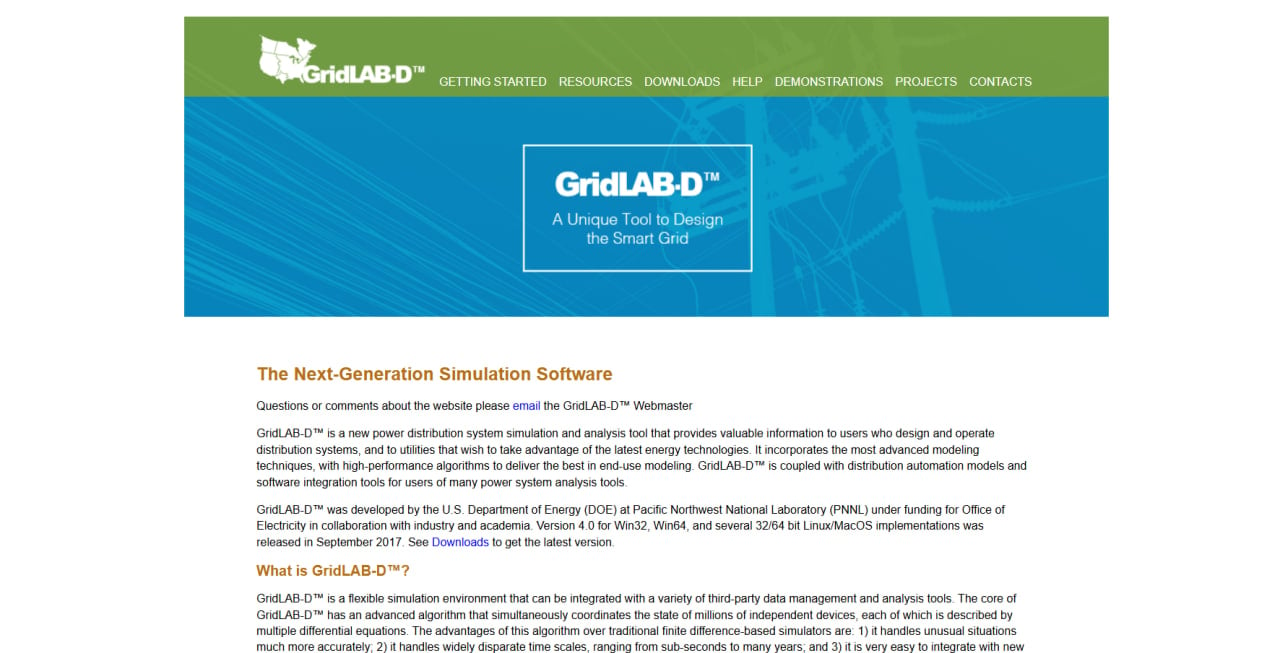
The transition toward a smarter, more decentralized electrical grid requires sophisticated modeling tools that can account for the complex interplay between traditional power distribution and modern energy technologies. GridLAB-D was developed to solve this specific problem by providing a flexible, high-performance simulation environment that captures the granular behavior of millions of independent devices.
Government planners, utilities, and researchers typically turn to this tool when they need to evaluate the technical and economic impacts of new technologies, such as solar storage, electric vehicle charging, and demand-response programs. By simulating these systems in detail, organizations can avoid costly assumptions and design more reliable, efficient grid programs.
What Is GridLAB-D?
GridLAB-D is an open-source power system simulation technology designed primarily for the analysis and design of modern power distribution systems. It falls under the category of power system simulation software and is widely used for storage and hybrid system design. Unlike traditional simulators that often rely on simplified, aggregate models, GridLAB-D utilizes an advanced algorithm to coordinate the state of millions of independent devices simultaneously, each governed by its own set of differential equations.
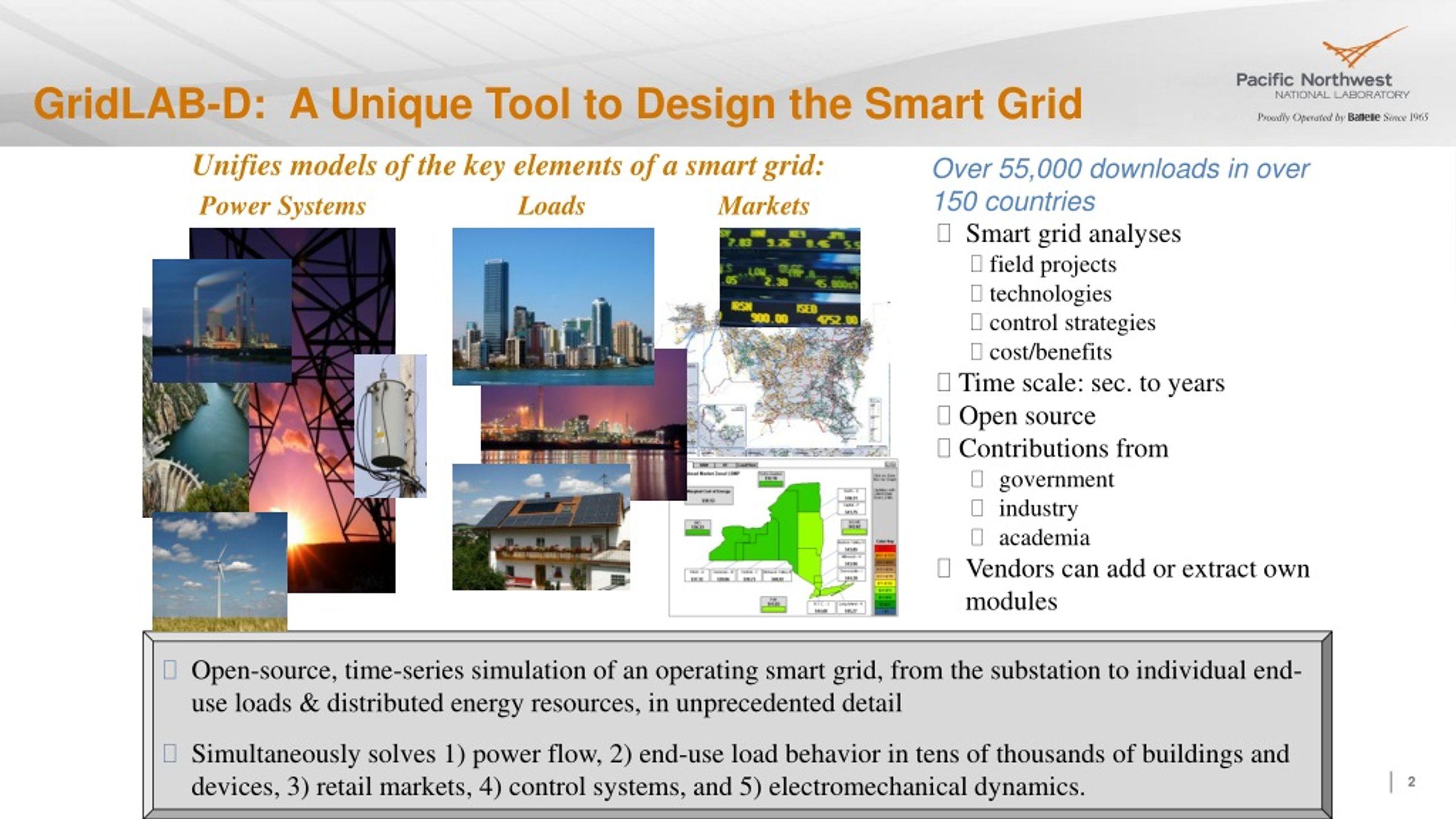
The platform is a research simulator originally developed by the US Department of Energy at the Pacific Northwest National Laboratory (PNNL) in collaboration with industry and academia. It is engineered to serve utility engineers, academic researchers, and energy technology developers. Its primary use cases include smart grid cost-benefit analysis, the study of future electricity distribution systems, and the integration of distributed energy resources (DER). As a verified trust signal, the project is backed by major government awards and has a long history of application in large-scale national simulations to determine the benefits of smart grid technologies.
Features
- Advanced Power Flow Analysis: Includes support for three-phase unbalanced load flow in both meshed and radial configurations, allowing for detailed modeling of real-world distribution networks.
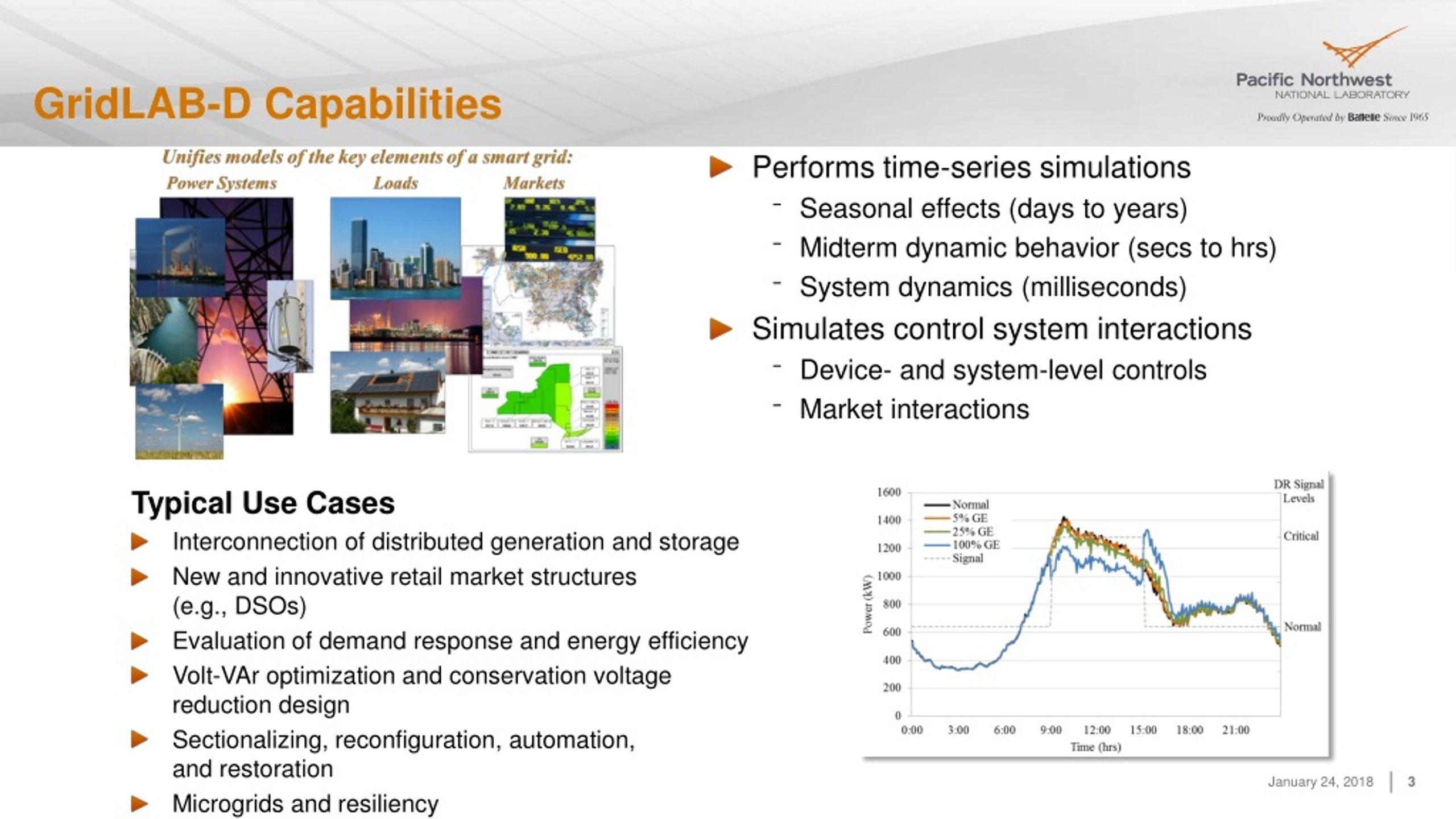
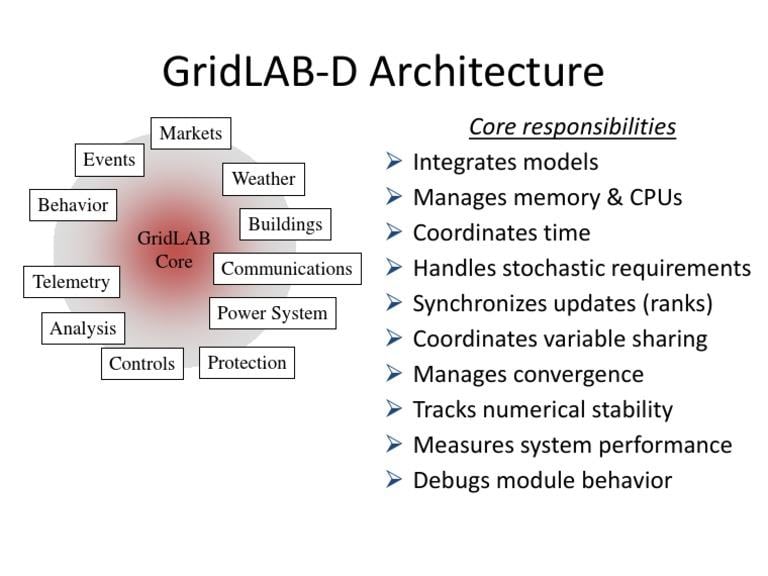
- Multi-Domain Modeling: Unifies power flow, end-use loads, and market functions into a single simulation, enabling users to see how retail price signals or weather changes impact physical grid performance.
- Time-Series Simulation: Supports variable time steps ranging from seconds to decades, making it suitable for both short-term stability studies and long-term infrastructure planning.
- Agent-Based Device Modeling: Models individual components like transformers, voltage regulators, and residential appliances as independent agents, which prevents the errors associated with reduced-order aggregate models.
- Distributed Energy Resource (DER) Integration: Provides specific models for PV systems, battery storage, and HVAC units to evaluate how renewable energy and storage impact grid stability.
- Market and Pricing Simulation: Includes a double-auction market object that allows objects within the simulation to base supply or demand on dynamic, real-time price signals.
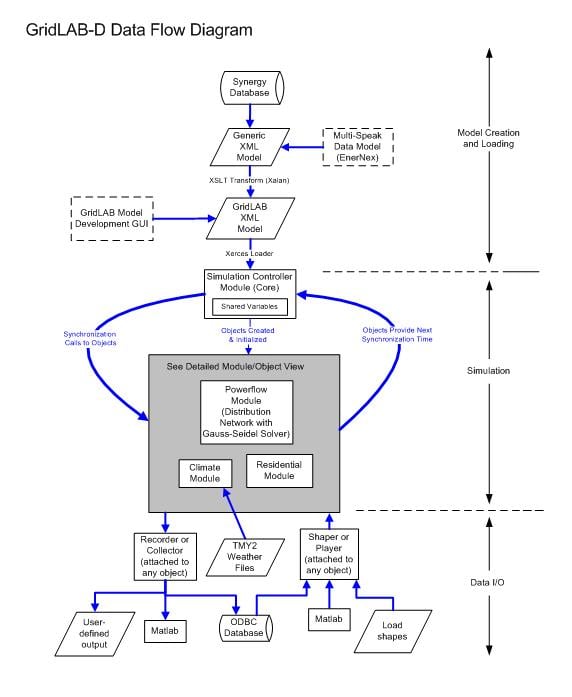
- Extensible Module Architecture: Features a system core that loads independent plug-in modules, allowing developers to add or extract specific modeling functionalities without altering the primary engine.
Screenshots
GridLAB-D Pricing
GridLAB-D is an open-source project released under the BSD license, making it free to download, use, and modify.
- Free Plan: The software is entirely free to download from its official website or GitHub repository.
- Paid Plans: There are no paid subscription tiers or commercial licensing fees for the core software.
- Usage-Based Fees: There are no usage-based fees.
- Enterprise and Custom Pricing: While the software is free, organizations often invest in third-party consultancy or internal engineering teams to manage complex implementations and hardware integrations.
Integrations
GridLAB-D is designed as a flexible environment that can be integrated with various third-party data management and analysis tools.
- Coding and Development: Integrates with GitHub for version control and collaborative development.
- Modeling Environments: Can be used with the WebGME modeling environment for visual system design.
- Data Processing: Supports standard industrial data formats for importing weather patterns, utility price signals, and consumer behavior data.
- API and Extensibility: Provides a C++-based API and supports modules developed independently by vendors or academic institutions.
- High-Performance Computing (HPC): The core is optimized to link with existing high-performance computing tools for large-scale national simulations.
How to Set Up GridLAB-D
- Visit the official GridLAB-D website or GitHub repository to download the latest stable version.
- Install the software core using a traditional installer or by compiling the source code for your specific operating system, such as Linux, macOS, or Windows.
- Configure the environment variables on your machine to ensure the core can locate and load the necessary plug-in modules.
- Download or create a test model file, typically a .glm file, such as the IEEE 13 Node Feeder, to verify the installation.
- Launch the simulation through the command-line interface or a supported GUI design studio.
How to Use GridLAB-D
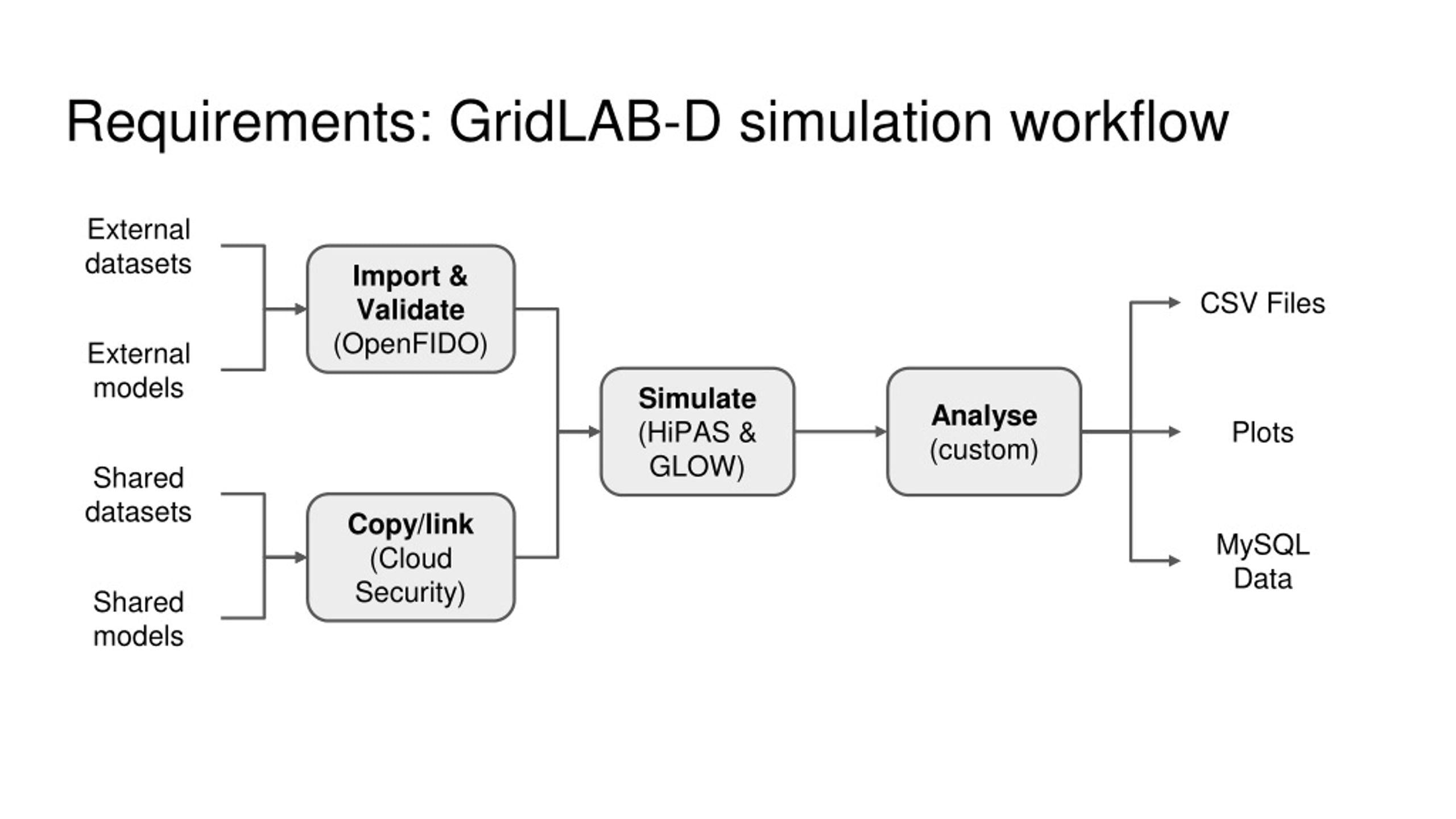
The standard day-to-day workflow in GridLAB-D involves creating or modifying .glm (GridLAB Model) files, which are textual representations of a distribution system. A user typically begins by defining the physical characteristics of the grid, including transformers, lines, and voltage regulators. They then layer in “”objects”” representing end-use loads, such as residential houses with specific HVAC settings and water heaters.
Once the model is defined, the user inputs external data files for weather patterns and price signals. Running the simulation produces output files, often in the form of recordings or histograms, which track variables like voltage stability, energy consumption, and total cost over the defined time period. Researchers then analyze these outputs to determine if a new technology—like a neighborhood battery storage system—provides the expected benefits or causes unintended consequences like voltage fluctuations.
What You Can Manage with GridLAB-D
- Power Distribution Models: Detailed digital twins of radial and meshed distribution networks.
- Smart Grid Cost-Benefit Analyses: Reports determining the financial viability of new energy technologies.
- Load Growth Projections: Simulations that predict how increasing demand will affect existing grid infrastructure over decades.
- Reliability Metrics: Evaluations of grid stability using IEEE 1366 standard metrics.
- Transactive Energy Programs: Management of demand-response and real-time pricing strategies.
- DER Impact Studies: Visibility into how high penetrations of PV and wind power affect local voltage and frequency.
FAQs
What does GridLAB-D do?
GridLAB-D is a simulation tool that creates highly detailed models of electrical distribution systems. It allows users to study how modern technologies, like solar panels and smart meters, interact with the traditional grid to improve efficiency and reliability.
Who is GridLAB-D best for?
The tool is primarily designed for utility planners, energy researchers, and government agencies. It is best suited for technical users who need to conduct complex, large-scale simulations that go beyond the capabilities of basic power flow software.
Is GridLAB-D free?
Yes, GridLAB-D is open-source software released under a BSD license, which means it is free to download and use for both academic and commercial purposes. There are no licensing fees or hidden subscription costs.
What are the main limitations of GridLAB-D?
The primary limitation is its high technical barrier to entry, as it lacks a fully integrated “”drag-and-drop”” interface found in many commercial tools. Additionally, because it is open-source, users must rely on community support and extensive documentation rather than a dedicated corporate help desk.
What are the best alternatives to GridLAB-D?
Common alternatives include commercial suites like CYME and ETAP, or other open-source tools like OpenDSS. While these tools also handle distribution analysis, GridLAB-D is often preferred for its unique ability to integrate market and end-use load modeling.