Tesla Autobidder
Pros
- Significant revenue optimization through AI-driven ""value stacking.""
- Managed over $330 million in trading profit for early storage investors.
- Deep integration with Tesla’s leading hardware (Megapack), ensuring high reliability.
- Operates autonomously 24/7, reducing the need for expensive human trading teams.
- Proven scalability with over 7 GWh of storage currently under management.
- Strong focus on battery longevity and warranty compliance.
- Adaptable to diverse global regulatory and market environments.
Cons
- Heavy prioritization and optimization for Tesla-branded hardware over third-party batteries.
- Lack of transparency regarding the specific logic of the underlying algorithms.
- No public pricing, making it difficult for smaller developers to benchmark costs.
- Cloud-only deployment may not suit utilities requiring on-premise control systems.
- High technical barrier to entry requiring significant capital and utility-scale infrastructure.
Managing large-scale energy storage assets requires complex decision-making to balance grid stability with financial returns. Owners of utility-scale batteries often struggle to navigate volatile energy markets while protecting the long-term health of their hardware. Tesla Autobidder addresses these challenges by providing an automated, AI-driven platform that manages the bidding and dispatch of energy storage systems.
The platform is primarily used by independent power producers, utilities, and capital partners who own or operate battery portfolios. By removing the need for manual intervention in fast-moving markets, Autobidder allows these organizations to maximize revenue and ensure their assets are operating according to specific business objectives and risk tolerances.
What Is Tesla Autobidder?
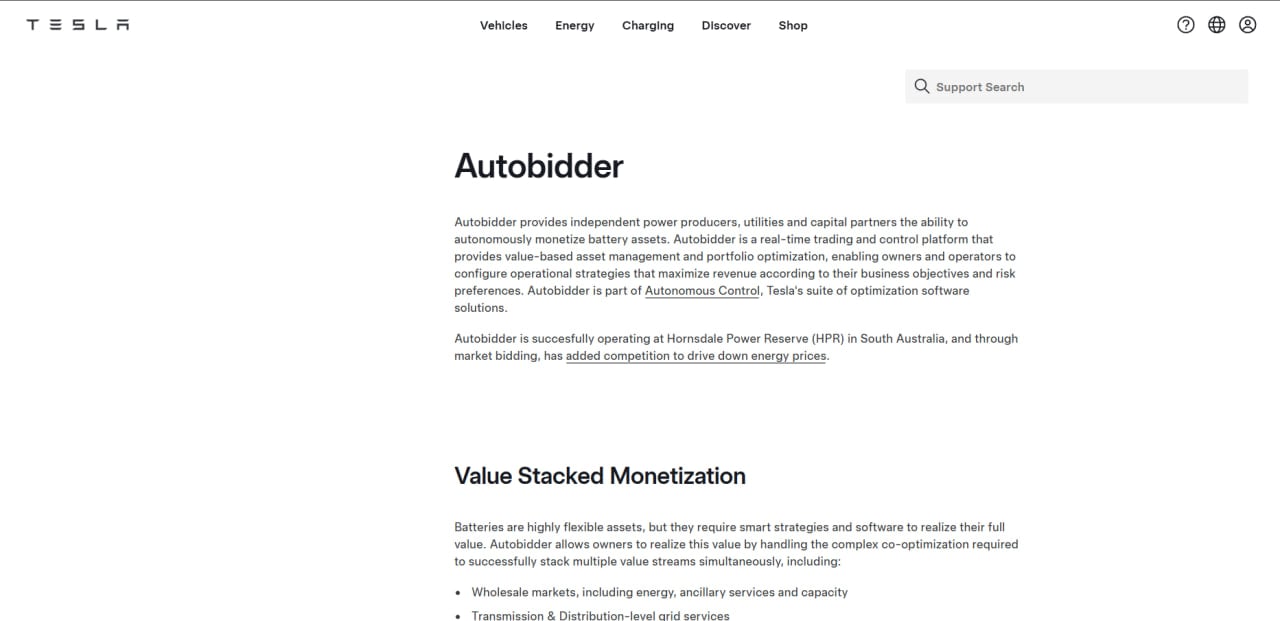
Tesla Autobidder is a real-time trading and control platform designed to autonomously monetize battery assets. It falls under the category of Battery Monitoring and Energy Management Systems (EMS). The software acts as an intelligent intermediary between energy storage hardware and the wholesale electricity markets, making high-frequency decisions on when to buy, store, or sell energy.
The platform works by leveraging “”Opticaster,”” Tesla’s machine-learning engine, which forecasts energy prices, load, and generation. This data allows the system to execute “”value-stacked”” monetization, which means it can simultaneously participate in multiple market services, such as frequency regulation and energy arbitrage. Currently, Autobidder manages over 7 GWh of battery storage globally and has a proven track record at major sites like the Hornsdale Power Reserve in Australia.
Features
- Price, Load, and Generation Forecasting: Uses machine learning to predict market conditions and demand, allowing for more accurate bidding strategies.
- Dispatch Optimization: Automatically determines the best time to discharge or charge batteries to capture the highest value while minimizing degradation.
- Value-Stacked Monetization: Enables assets to participate in multiple revenue streams at once, such as wholesale trading and ancillary services.
- Automated Market Bidding: Executes high-speed bids in electricity markets without the need for manual human trading desks.
- Warranty Protection Management: Monitors battery health and cycles to ensure that operational strategies do not violate manufacturer warranty terms.
- Scalable Portfolio Management: Allows operators to manage a single site or a global fleet of energy storage assets from a centralized interface.
- Smart Bidding Algorithms: Adapts to specific market rules and regulatory environments, ensuring compliance while maximizing financial performance.
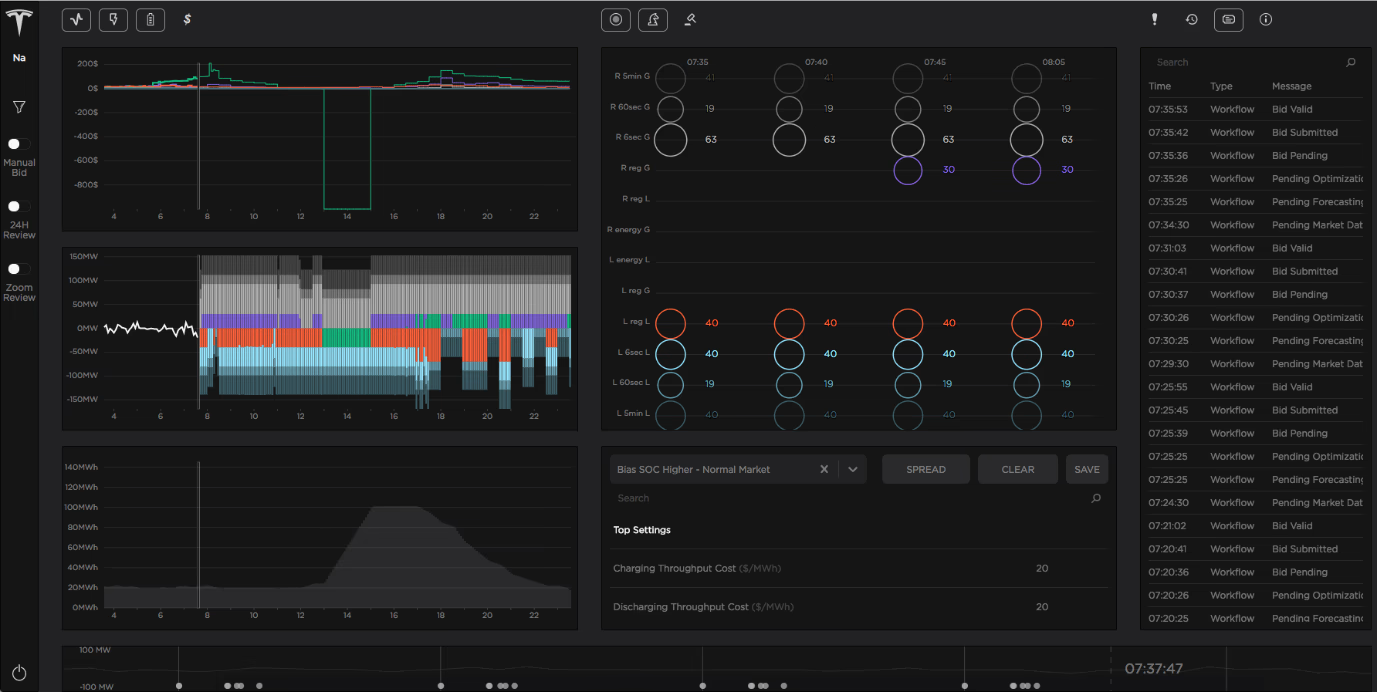
Screenshots
Tesla Autobidder Pricing
Pricing is not publicly listed. To get a figure for Tesla Autobidder, teams book a demo or go through the sales team. Because the software is typically bundled with large-scale utility projects like the Tesla Megapack, costs are often integrated into the broader project financing and service agreements.
Integrations
- Tesla Hardware Integrations: Optimized for seamless use with Tesla Megapack and Powerwall systems.
- Market Operator Interfaces: Integrates directly with regional transmission organizations (RTOs) and independent system operators (ISOs) globally, such as ERCOT in Texas or AEMO in Australia.
- Opticaster: Deeply integrated with Tesla’s proprietary forecasting engine for real-time data processing.
- API and Webhooks: Provides programmatic access for enterprise users to pull performance data into their own internal reporting tools.
How to Set Up Tesla Autobidder
- Contact the Tesla Energy sales team to initiate a site audit and project feasibility study.
- Purchase and install Tesla energy storage hardware, such as the Megapack or Powerwall.
- Commission the on-site Microgrid Controller and communication hardware.
- Configure business objectives, risk preferences, and operational constraints within the platform.
- Link the system to the relevant local energy market operator for automated bidding.
- Monitor performance through the centralized dashboard as the system begins autonomous dispatch.
How to Use Tesla Autobidder
The daily workflow for an asset manager using Autobidder is largely supervisory. Because the system is autonomous, users do not typically enter manual trades. Instead, they log into the dashboard to review real-time performance metrics and revenue generation. Operators spend time analyzing the “”Portfolio Analysis”” view to see how different sites are performing against market forecasts.
When market conditions change or new regulations are introduced, managers adjust the high-level operational strategies. For example, they might change the “”risk preference”” setting to prioritize battery health over aggressive trading during periods of extreme price volatility. The platform also generates detailed reports that are used for financial audits and sustainability tracking.
What You Can Manage with Tesla Autobidder
- Energy Storage Portfolios: Centralized control over multiple utility-scale battery sites.
- Market Bidding Strategies: Automated execution of complex trading logic in wholesale markets.
- Revenue Streams: Management of energy arbitrage, frequency response, and spinning reserves.
- Battery State of Health: Tracking of degradation, cycles, and warranty status.
- Financial Performance Reports: Real-time data on trading profits and operational costs.
- Grid Compliance: Automated adherence to local grid codes and market participation rules.
FAQs
What does Tesla Autobidder do?
Autobidder is an autonomous trading and control platform that manages the dispatch of battery storage systems. It uses machine learning to forecast market conditions and execute bids that maximize revenue for asset owners.
Who is Tesla Autobidder best for?
The tool is designed for utility-scale energy producers, grid operators, and institutional investors. It is specifically built for those managing large battery installations like the Tesla Megapack.
Is Tesla Autobidder free?
No, it is a premium enterprise-grade software solution. Pricing is generally provided as part of a custom quote for large energy projects and is not available to the general public.
What are the main limitations of Tesla Autobidder?
The primary limitation is its vertical integration; while it can technically manage other batteries, it is heavily optimized for Tesla hardware. It also lacks a local on-premise installation option, as it is a cloud-based service.
What are the best alternatives to Tesla Autobidder?
Common alternatives for energy storage optimization include Habitat Energy PowerIQ, Fluence Mosaic, and Stem’s Athena platform. Each offers different levels of hardware agnosticism and algorithmic transparency.