HOMER Grid
Pros
- Industry-trusted calculation engine based on foundational NREL research methodologies.
- Combines economic analysis and complex engineering calculations in a single workflow.
- Accurate tools for modeling time-of-use utility rates and reducing demand charges.
- Advanced modeling for modern use cases such as EV charging networks and battery-backed resilience.
- Extensive automated sensitivity testing that helps stakeholders reduce financial risk.
Cons
- Lacks native CAD features and visual drafting tools for 3D layouts or structural roof modeling.
- Has a steep initial learning curve due to its analytical depth and detailed engineering inputs.
- Standard packages are limited to a local desktop environment rather than a collaborative cloud-based platform.
Commercial and industrial facilities are facing more pressure than ever to navigate complicated utility rates, slash peak demand charges, and lower their carbon footprints. Meeting these challenges head-on means finding the perfect balance between on-site solar, energy storage, and the shifting daily needs of the facility.
HOMER Grid takes the guesswork out of these complex problems by combining deep engineering analysis with economic realities in one smooth, user-friendly modeling platform. By analyzing local utility rates and historical weather data, the software lets engineers and developers test hundreds of different setups to find the most cost-effective option before construction ever begins.
What Is HOMER Grid?
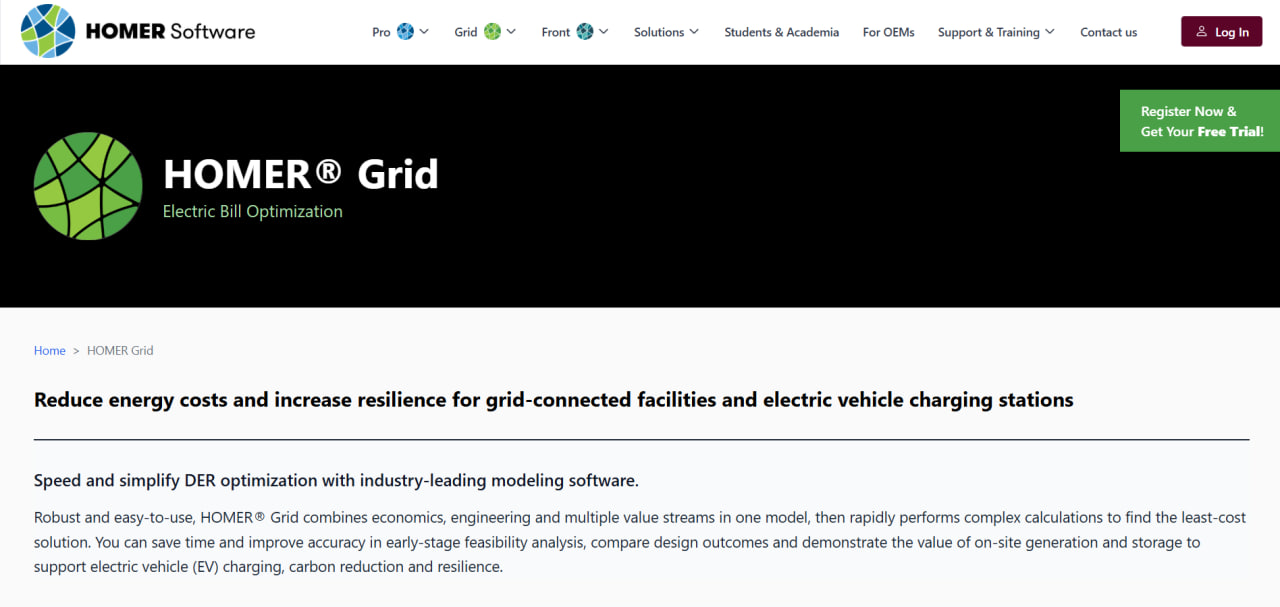
HOMER Grid is a desktop simulation and optimization platform built specifically for grid-connected, behind-the-meter renewable energy systems. Originally developed at the National Renewable Energy Laboratory (NREL), the software is trusted worldwide by a community of over 250,000 users across 190 countries.
The platform is designed to help facility energy managers, solar installers, developers, and engineering consultants design hybrid systems for commercial, industrial, and institutional properties. By running precise, hour-by-hour energy balance calculations for an entire year, HOMER Grid models exactly how power flows through different generation and storage assets while clearly showing key financial metrics such as return on investment and payback periods.
Features
- Sizing optimization: Automatically tests hundreds of system sizes to identify the ideal combination of solar, wind, and battery storage that delivers the lowest total lifecycle cost.
- Demand charge management: Compares a facility’s peak-load data against complex utility structures to show how on-site generation and batteries can lower peak demand fees.
- EV charging station modeling: Simulates and optimizes EV charging infrastructure, helping users match vehicle charging patterns with on-site generation or deferrable energy demand.
- Resilience and reliability analysis: Models how hybrid systems perform during grid outages or emergencies, demonstrating their value to businesses that require grid independence or backup power.
- Comprehensive tariff building: Connects to the Genability tariff database to retrieve regional utility rates while allowing teams to create custom structures for complex commercial or industrial tariffs.
- Sensitivity analysis: Runs multivariable simulations to show how project economics may change if fuel costs increase, equipment prices shift, or a facility’s energy demand grows over time.
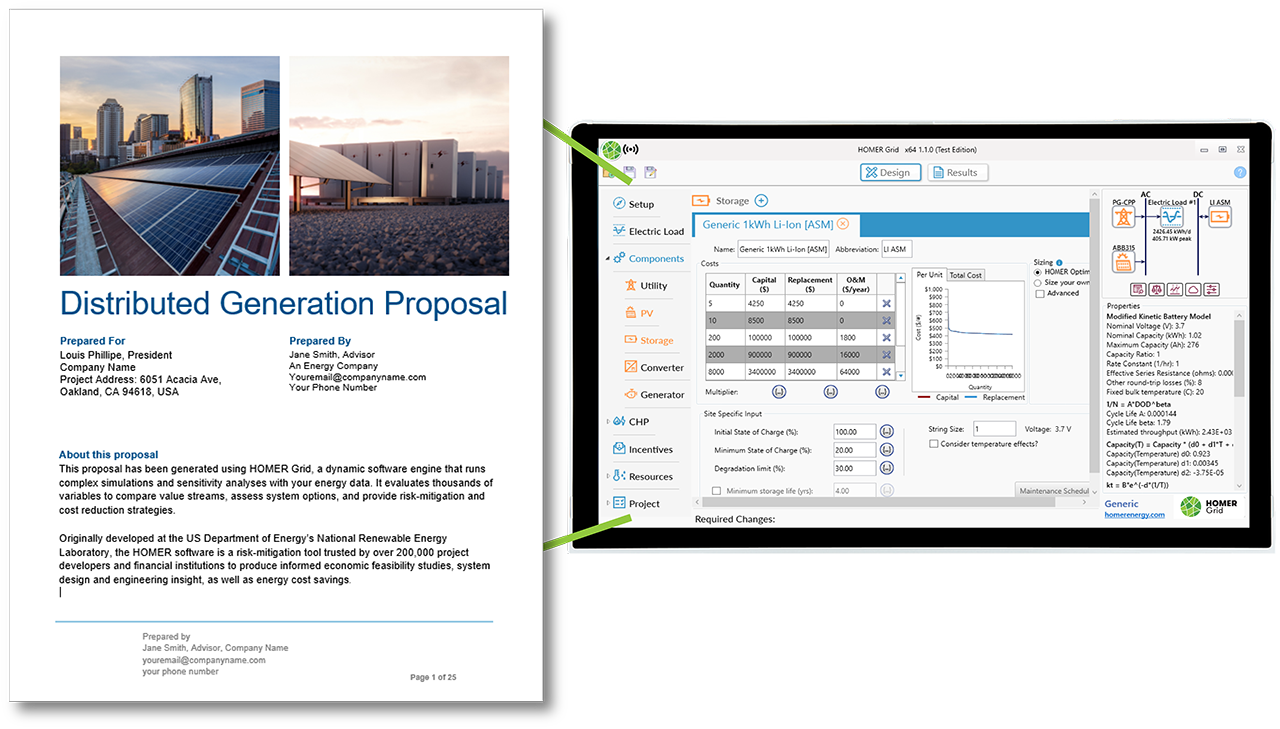
Screenshots
HOMER Grid Pricing
HOMER Grid is available through subscription licenses tied to individual user seats. Its standard pricing options include:
- Free trial: A 14-day free trial is available so new users can test the platform’s features before subscribing.
- Annual plan: Standard pricing is $350 per month, billed annually at $4,200 per year.
- Monthly plan: A flexible monthly subscription is available for $665 per month, totaling $7,980 if used for a full year.
- Academic and student licenses: Discounted rates are available for accredited educational institutions, although usage is limited to non-commercial teaching and research.
- Add-on packages: Teams can expand their workflows with specialized system add-ons, custom training, and dedicated support.
Integrations
Although public information about native application integrations is limited, HOMER Grid provides useful database connections and export options:
- Utility databases: Includes built-in access to the Genability tariff database for accurately modeling regional electricity rates across different territories.
- Environmental resources: Connects with NASA databases to download historical solar radiation and wind data based on specific project coordinates.
- Custom analysis: Allows users to export simulation data for deeper analysis of hourly performance or multiyear hardware degradation in external tools.
How to Set Up HOMER Grid
- Visit the official website and download the desktop installation wizard.
- Register an account to begin the 14-day free trial or activate a purchased single-user license key.
- Enter the project’s exact location to retrieve local climate data and regional Genability utility tariffs.
- Upload the facility’s 15-minute or hourly historical electrical load profiles to map its consumption patterns.
- Build the hybrid system model by adding components such as solar arrays, wind equipment, and battery storage.
How to Use HOMER Grid
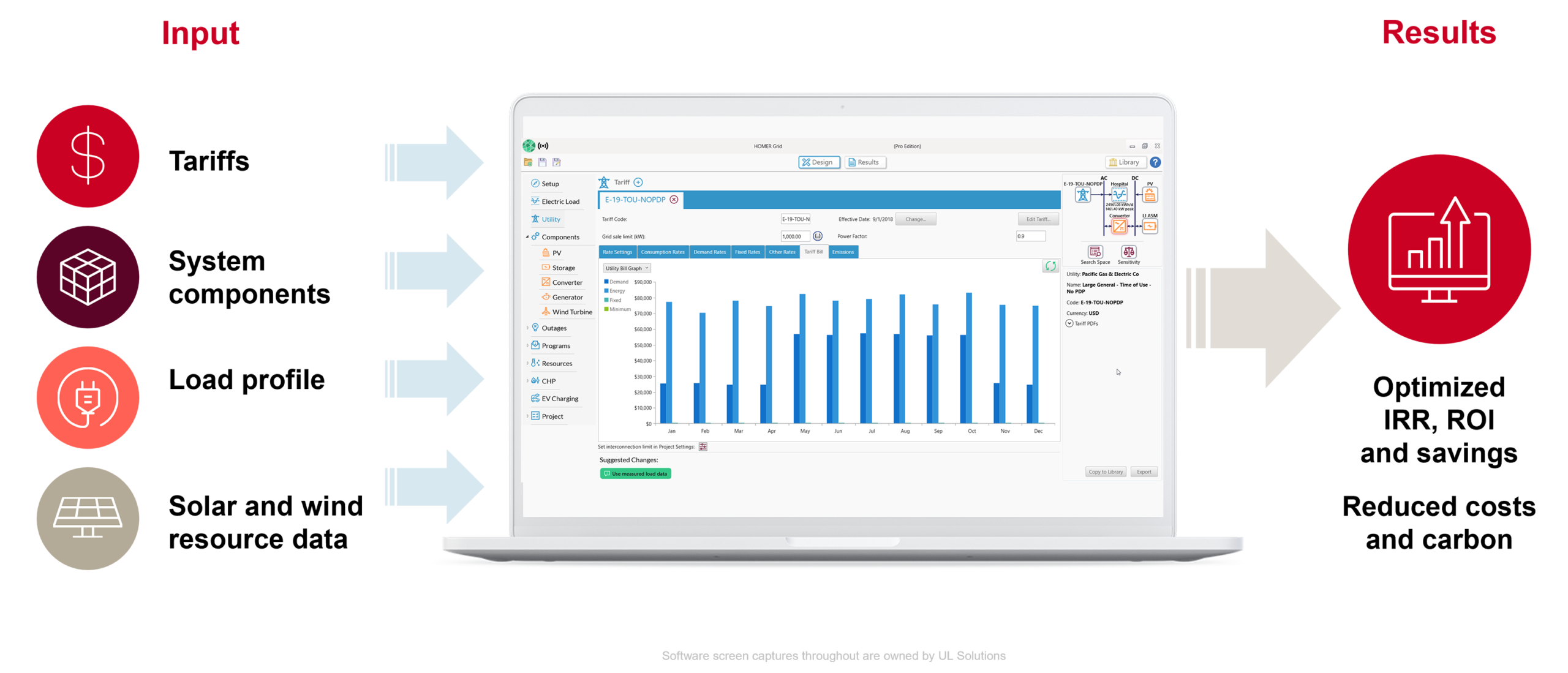
A typical project begins by setting the location and defining the facility’s electrical demand. Users can enter actual historical load curves or use built-in templates that represent common facility operating patterns. They can then select equipment from the component catalog and specify its size, cost, and performance characteristics.
Once the model is ready, the simulation engine calculates a full year of performance on an hour-by-hour basis. It balances energy production against real-world demand and identifies when it makes the most financial sense to store electricity, draw power from the grid, or discharge battery reserves.
Developers can review the ranked results to identify the configurations that deliver the greatest savings. Sensitivity analysis can then be used to evaluate how those configurations might perform under future changes in utility rates, fuel prices, equipment costs, or energy demand.
What You Can Manage with HOMER Grid
- Project feasibility reports: Data-driven documents detailing the engineering requirements and technical constraints of a proposed microgrid site.
- ROI and financial comparisons: Cash-flow analyses showing payback periods, upfront capital requirements, and projected utility savings.
- Battery dispatch strategies: Custom operating rules that determine when storage systems should charge or discharge to maximize demand-charge savings.
- Emissions accountability records: Quantifiable projections of annual carbon emissions that support corporate sustainability and compliance goals.
FAQs
What does HOMER Grid do?
HOMER Grid is an engineering and economic optimization tool used to plan behind-the-meter, grid-connected power systems. It identifies the most cost-effective combination of components needed to meet a facility’s energy demand while reducing expensive utility demand charges.
Who is HOMER Grid best for?
The platform is designed for commercial and industrial solar developers, system installers, facility engineers, engineering consultants, and microgrid architects. It is particularly useful for teams that need to build detailed business cases for hybrid energy projects or EV charging hubs.
Is HOMER Grid free?
HOMER Grid is premium professional software, but new users can register for a fully functional 14-day free trial. The company also provides simplified web-based sizing tools for quick exploratory calculations.
What are the main limitations of HOMER Grid?
The platform focuses on mathematical modeling, simulation, and project economics. It does not include native layout-design tools, 3D roof mapping, or physical site-drafting features. The standard software is also tied to a local desktop deployment rather than a shared cloud workspace.
What are the best alternatives to HOMER Grid?
Strong alternatives include the National Renewable Energy Laboratory’s free System Advisor Model (SAM), cloud-based microgrid design platforms such as Xendee, and behind-the-meter storage analysis tools such as Energy Toolbase.