HOMER Front
Pros
- Industry-trusted analytical depth backed by the proven UL Solutions modeling engine.
- Advanced lifecycle degradation modeling that accounts for battery temperature and health limits.
- Detailed revenue-stacking analysis across wholesale, capacity, ancillary service, and PPA options.
- Reduces financial risk by identifying ideal component sizes before equipment is purchased.
- Evaluates projects across major global power markets using flexible import and export rules.
Cons
- The price can be steep compared with tools designed for residential or small commercial solar projects.
- No built-in visual layout features for generating 3D roof plans, site maps, or customer proposals.
- Focused entirely on analysis and planning, with no CRM, live dispatch management, or real-time control capabilities.
- Has a noticeable learning curve and requires a solid understanding of grid engineering and energy markets.
Big renewable energy projects cost a lot to get off the ground and have to navigate ever-changing power markets. Developers, financiers, and engineers constantly have to balance system sizes with battery wear-and-tear, merchant sales, and shifting capacity prices to make sure the numbers work out long-term. HOMER Front steps in to solve this, giving teams a smart analytics hub to simulate and map out the true financial viability of complex hybrid energy projects.
Built specifically for front-of-the-meter utility applications, this software takes the guesswork and risk out of early-stage planning and bidding. Thanks to smart optimization algorithms, it pinpoints the perfect mix of solar, wind, and battery storage systems (BESS) so you can tap into multiple revenue streams without wasting money on oversized capacity.
What Is HOMER Front?
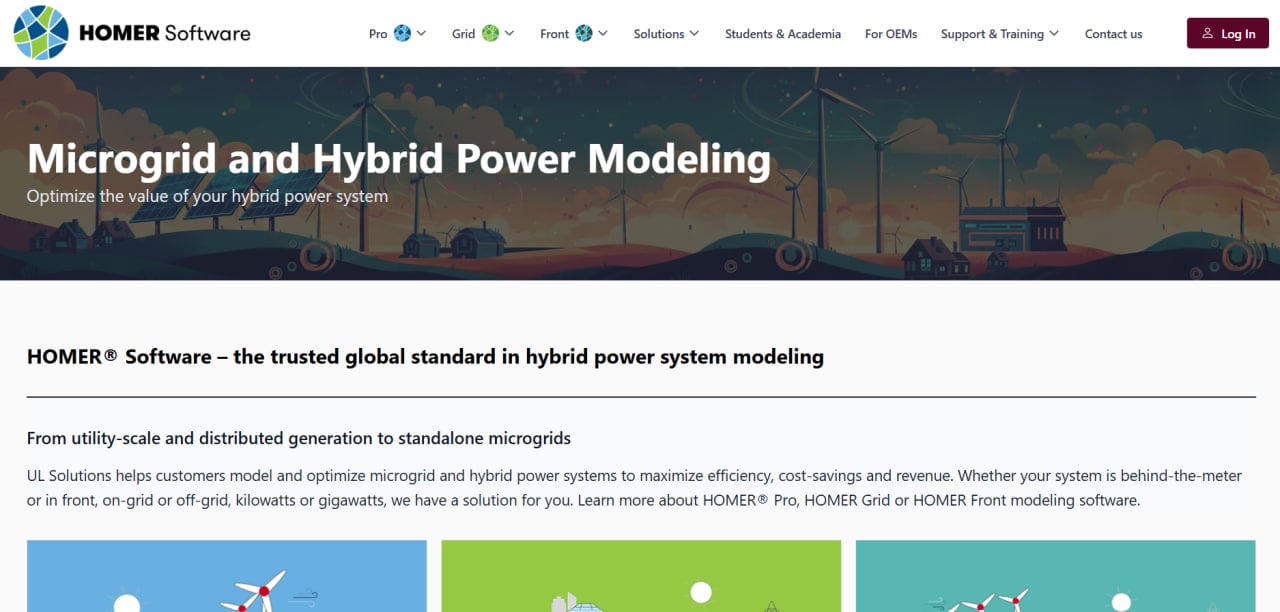
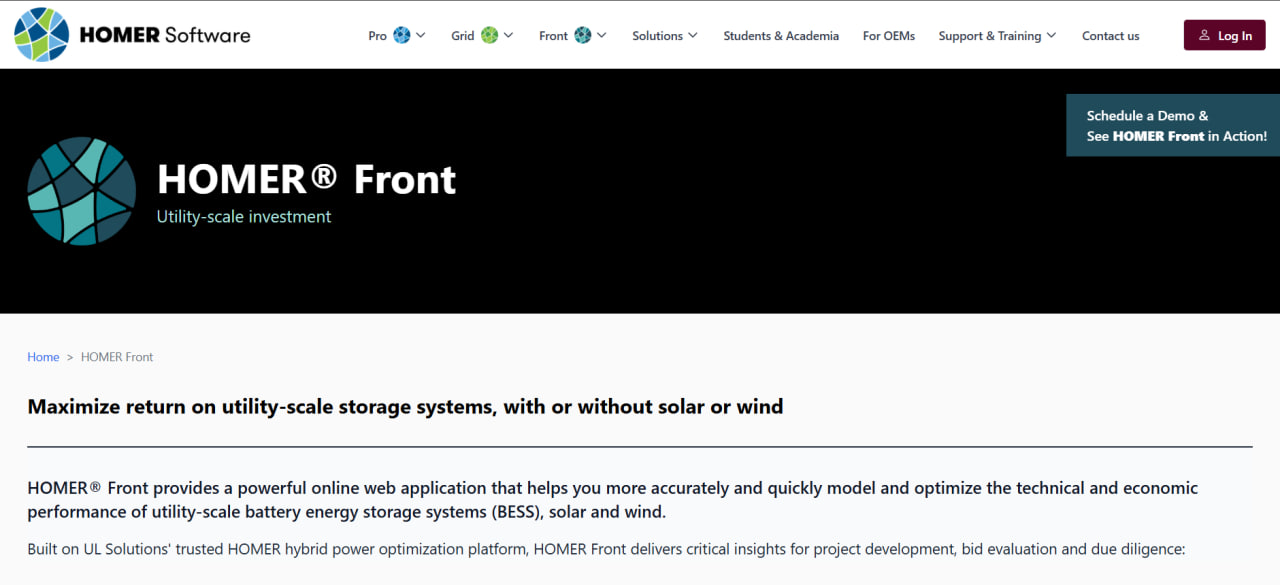
HOMER Front is a cloud-based hybrid optimization app created by UL Solutions as part of its ULTRUS software family. Rather than focusing on visual layouts, it serves as a deep engineering and financial analysis tool built for project developers, investors, consultants, and grid analysts managing utility-scale systems.
Running on the trusted HOMER platform—already relied on by over 250,000 energy professionals worldwide—the app makes it easy to size and model standalone batteries or paired solar-plus-storage and wind-plus-storage setups. It runs simulations against major global power markets to show how equipment will perform when facing real-world wholesale prices, capacity payouts, and power purchase agreements (PPAs).
Features
- Hybrid system optimization: Automatically calculates the technical and financial performance of paired assets, such as solar PV, wind, and batteries, to identify the most cost-effective setup.
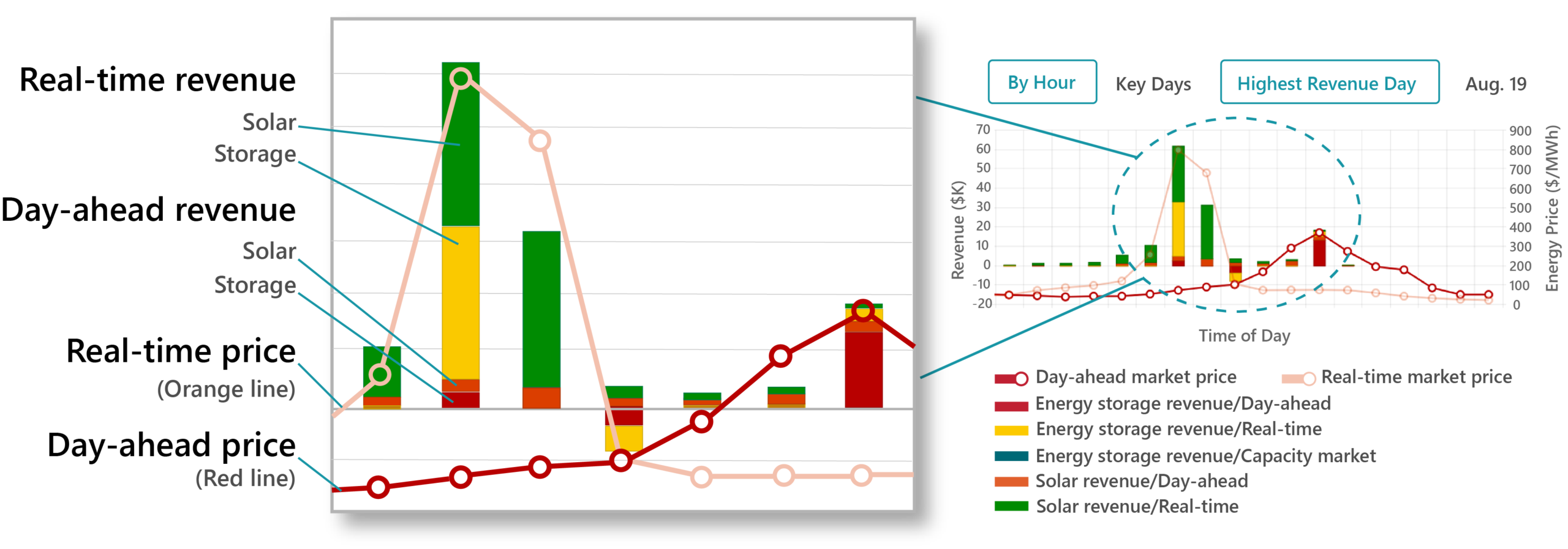
- Market revenue modeling: Simulates returns across multiple revenue structures, including wholesale merchant markets, capacity stacking, ancillary services, and fixed PPAs.
- State-of-health lifecycle modeling: Tracks battery degradation over time based on custom retirement rules, keeping lifecycle projections aligned with real operating conditions.
- Automated environmental calculations: Simplifies complex engineering work by automating temperature impacts and battery degradation calculations within the active storage library.
- Sensitivity analysis: Lets users define broad ranges for equipment costs, resource availability, and grid constraints to run thousands of what-if scenarios.
- Global market evaluation: Includes built-in tools for evaluating systems against major regional energy markets using customizable import and export pricing models.
Screenshots
HOMER Front Pricing
HOMER Front uses a subscription-based pricing model:
- One-year commercial license: $7,700 per year.
- Enterprise, API, and academic licensing: Available through a custom quote from UL Solutions.
Integrations
HOMER Front functions as a central modeling engine, with data connections focused on analytical workflows:
- Component library integrations: Connects to predefined equipment libraries containing performance data for utility-scale batteries, solar panels, and inverters.
- Global market and resource databases: Connects with regional utility-rate structures and historical global weather and solar datasets.
- Downstream layout tools: Although it does not provide visual mapping, simulation results can be exported into external design and layout software such as SurgePV.
How to Set Up HOMER Front
- Visit the official UL Solutions or HOMER Energy website to request access or purchase a subscription.
- Log in to the web application using your secure credentials.
- Set the project’s geographic location to retrieve local weather, solar irradiance, and market-rate data.
- Select the required battery types, solar modules, and inverters from the built-in component libraries.
- Enter economic variables such as state-of-health limits, tariff rules, and expected PPA conditions.
How to Use HOMER Front
A standard workflow in HOMER Front begins by defining the parameters of a front-of-the-meter project. Users load relevant energy-market pricing data and select the storage and renewable resources they want to evaluate. Instead of drawing panels manually, they provide a range of component sizes for the software to consider.
The simulation engine then evaluates hundreds or thousands of system combinations to determine how each hybrid configuration would operate hour by hour under different conditions. The optimization tool processes and ranks the results to identify the configurations that maximize internal rate of return (IRR).
Engineers can then use the sensitivity-analysis tools to assess how the leading designs would perform if equipment costs increased or energy-market prices declined in the future.
What You Can Manage with HOMER Front
- Hybrid system configurations: Exact sizing ratios among solar, wind, and battery assets.
- Financial performance projections: Long-term revenue analysis, including internal rate of return and capital expenditure optimization.
- Battery lifecycle models: Predictions covering battery degradation, temperature variables, and future replacement schedules.
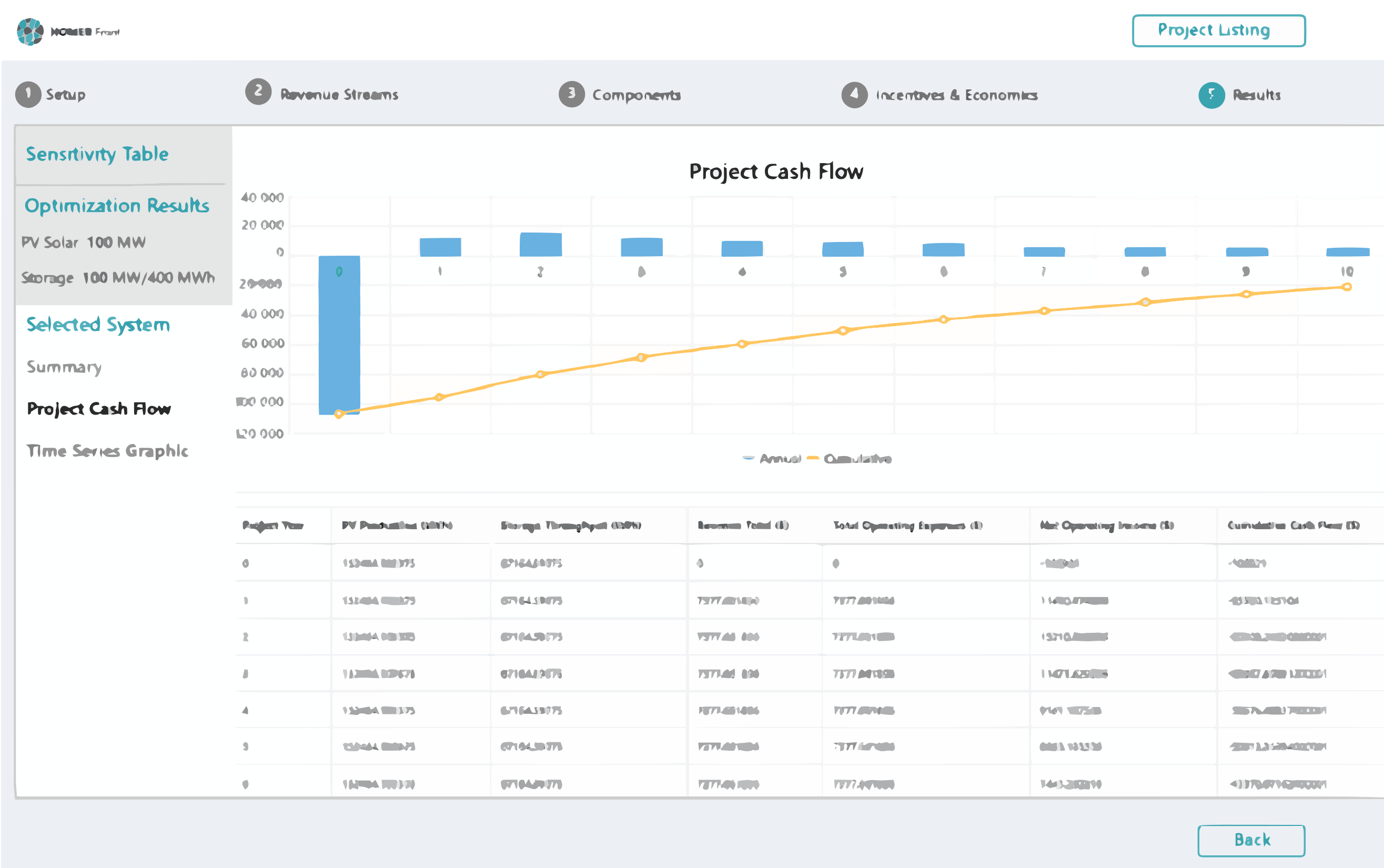
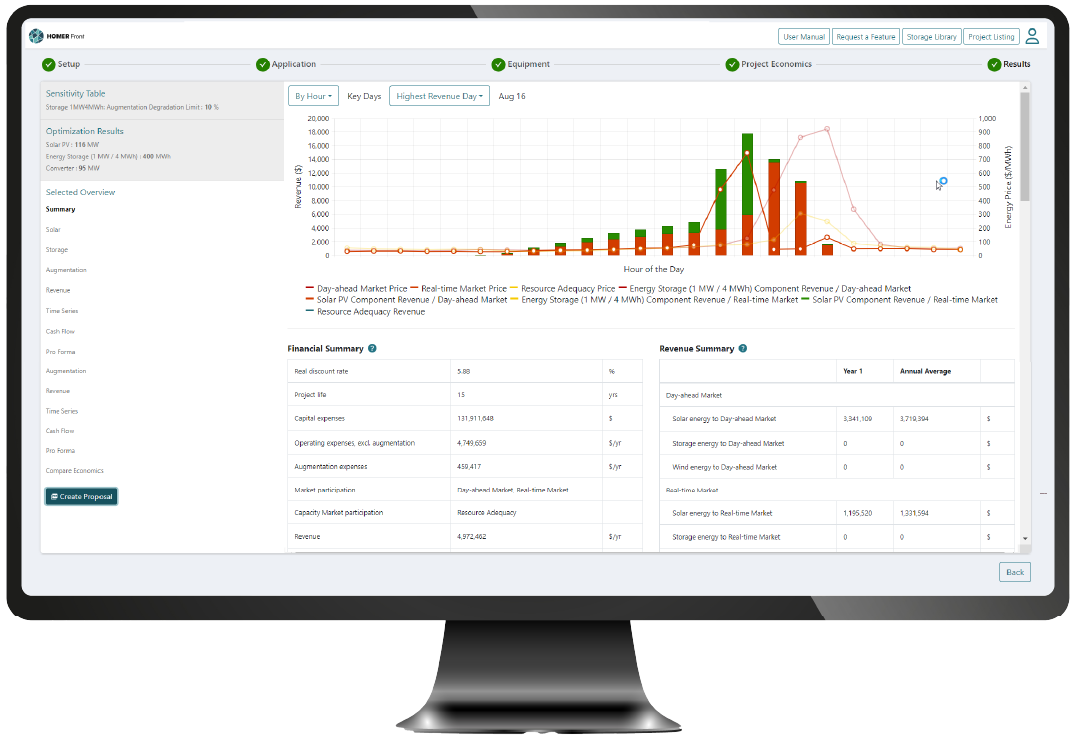
- Revenue-stacking profiles: Charts and graphs illustrating market participation, capacity payments, ancillary services, and utility revenue.
FAQs
What does HOMER Front do?
HOMER Front is a web-based simulation and optimization tool used to analyze the technical and financial feasibility of utility-scale battery storage and hybrid energy systems. It models how physical equipment may perform under complex energy-market conditions and contractual structures.
Who is HOMER Front best for?
The platform is designed for utility-scale project developers, investors, independent power producers (IPPs), energy consultants, and grid analysts working with front-of-the-meter systems.
Is HOMER Front free?
No, HOMER Front is a premium commercial tool. A standard commercial subscription costs $7,700 per year, while enterprise, API, and academic packages require custom quotes.
What are the main limitations of HOMER Front?
It lacks physical layout and drafting features, CRM tools for tracking customers, and live operational dispatch capabilities. The platform is designed specifically for analytical simulation and financial modeling before a project is built.
What are the best alternatives to HOMER Front?
Alternatives depend on the specific use case, but utility-scale teams may consider other grid-optimization platforms, custom MATLAB models, or specialized engineering and financial-analysis tools.