Open Access Technology International DERMS
Pros
- Deep industry experience backed by more than three decades of energy-sector expertise.
- Comprehensive capabilities covering everything from customer enrollment to wholesale market settlement.
- Proven scalability across rural electric cooperatives and major investor-owned utilities.
- High reliability supported by OATI-operated private data centers and a robust security posture.
- Strong focus on AI-driven analytics for forecasting and optimization.
- Recognized for its interoperability and user interface.
- Modular design allows utilities to start with selected capabilities and expand over time.
Cons
- Complex enterprise-level setup that typically requires significant implementation time.
- High barrier to entry for smaller organizations due to its comprehensive scope and likely cost.
- Initial integration with legacy third-party systems may present technical challenges.
- Pricing is not publicly disclosed, requiring a formal sales process to determine baseline costs.
- The feature set may be overly complex for utilities that only require basic demand response tools.
The rapid expansion of distributed energy resources (DERs), such as residential solar, battery storage, and electric vehicles, has introduced significant complexity for traditional utility operations. Managing these decentralized assets requires a shift from passive distribution to active, real-time orchestration to ensure grid stability and optimize market participation.
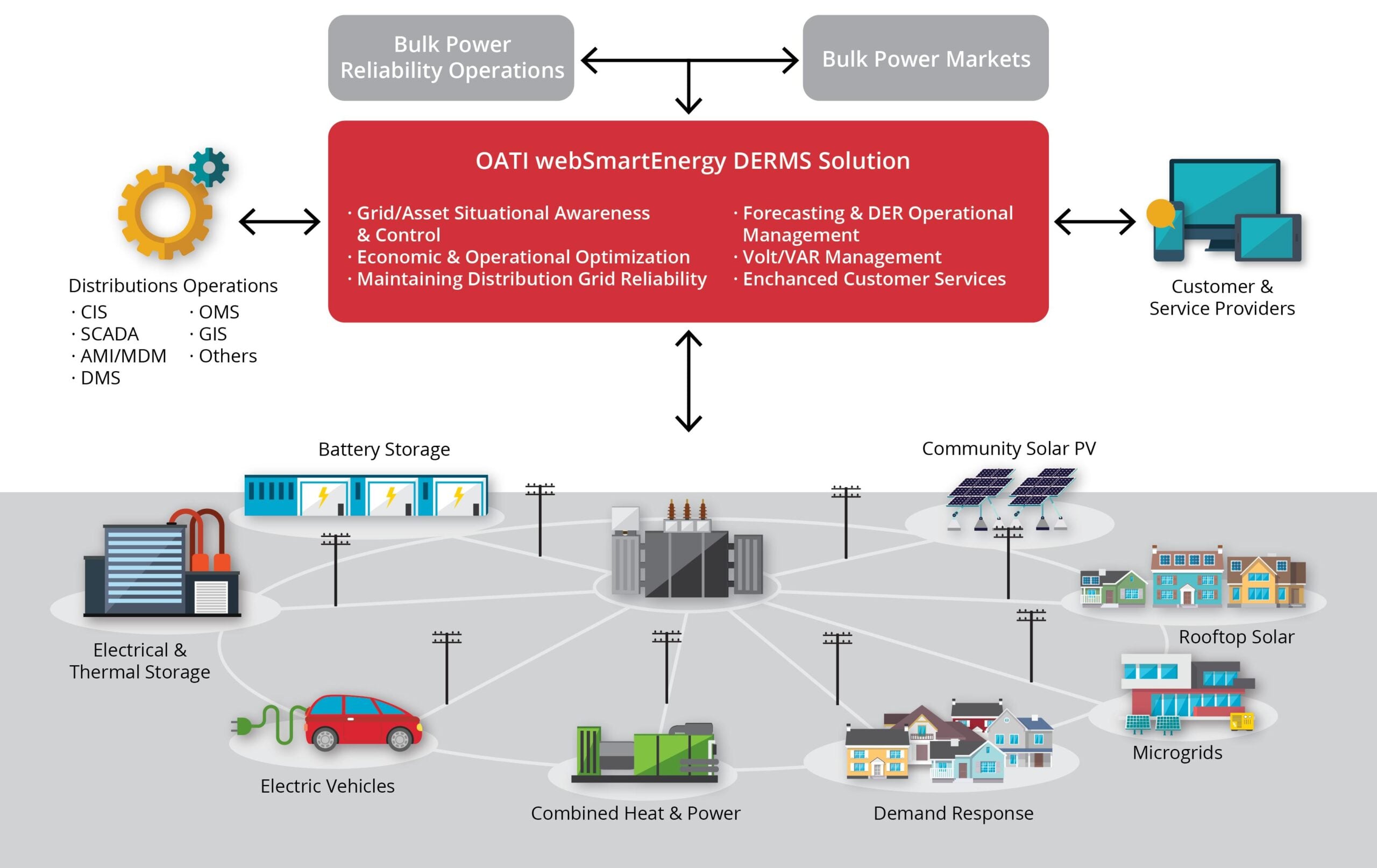
Open Access Technology International (OATI) addresses these challenges with its Distributed Energy Resource Management System (DERMS). This platform provides the tools utilities need to aggregate, monitor, and control a wide variety of grid-edge assets. By bridging the gap between operational technology (OT) and information technology (IT), it helps utilities transform fragmented resources into reliable virtual power plants (VPPs).
What Is Open Access Technology International DERMS?
Open Access Technology International DERMS is an enterprise-grade software platform designed to manage the full lifecycle of distributed energy resources. It falls into the category of Distributed Energy Resource Management Systems and is specifically engineered for investor-owned utilities (IOUs), generation and transmission cooperatives (G&Ts), and municipal utilities.
At a high level, the platform connects to on-site hardware—including smart meters, thermostats, inverters, and EV chargers—and aggregates their data into a unified interface. This enables utilities to perform grid-aware dispatch, ensuring that DER activity does not violate local distribution constraints while still meeting system-wide goals.
OATI is a long-standing energy industry provider founded in 1995, and its DERMS platform was among the first deployed in the industry in 2009. Today, it is used by hundreds of utilities across North America and has been recognized as a market leader by independent research firms such as Verdantix.
Features
- VPP aggregation and orchestration: Allows utilities to group thousands of small-scale assets into a single virtual power plant that can provide ancillary services or energy to the wholesale market.
- Real-time telemetry and control: Provides sub-second visibility into the performance of enrolled assets, enabling precise, dynamic signaling to batteries and other fast-responding resources.
- Grid constraint management: Ensures that DER dispatch commands stay within the physical limits of the distribution network, preventing overloads and voltage issues.
- Customer engagement and enrollment: Includes tools that allow utility customers to enroll their smart devices in programs through a streamlined interface for participation and incentives.
- Load shape forecasting: Uses advanced algorithms and historical data to predict future energy needs and DER availability, helping utilities prepare for peak-demand periods.
- Market integration and settlement: Automates the process of bidding DER capacity into wholesale markets and manages the complex financial settlements required for program participants.
- Multi-tenant architecture: Supports complex organizational structures, allowing one platform to serve multiple subsidiaries or distribution partners while maintaining data privacy.
Open Access Technology International DERMS Pricing
Pricing is not publicly listed. Quotes for Open Access Technology International DERMS come out of a scoping call or a product demo.
Because the platform is highly modular and typically involves enterprise-level deployment across large utility networks, costs are determined by the selected use cases, number of connected devices, implementation requirements, and scale of the service territory.
Integrations
OATI DERMS is designed to interoperate with a utility’s existing technical infrastructure:
- Utility operational systems: Integrates with Advanced Distribution Management Systems (ADMS), SCADA systems, and Geographic Information Systems (GIS).
- Hardware and IoT: Supports a wide range of grid-edge devices through standard protocols such as IEEE 2030.5, OpenADR, and Modbus.
- Market systems: Connects directly to Independent System Operators (ISOs) and Regional Transmission Organizations (RTOs) for wholesale market participation.
- Enterprise systems: Can connect with customer relationship management (CRM) and billing software to streamline program administration.
How to Set Up Open Access Technology International DERMS
- Request a consultation and product demo from the OATI sales team to define your utility’s specific use cases.
- Conduct a technical audit of the existing grid infrastructure and legacy IT and OT systems.
- Work with OATI engineers to design a modular implementation plan tailored to the service territory.
- Deploy the software in OATI’s secure private cloud environment or on-site, depending on organizational requirements.
- Configure asset hierarchies, grid constraints, and customer enrollment portals.
- Conduct field testing with a pilot group of DERs before moving to full-scale orchestration.
How to Use Open Access Technology International DERMS
A typical day for a utility operator involves logging into the central dashboard to monitor the distribution grid and the availability of aggregated DERs. When a peak-demand event is forecast, the operator can use the platform to schedule a dispatch or trigger a demand response event across selected virtual power plants.
The software automatically communicates with individual customer devices—for example, by adjusting smart thermostat setpoints or discharging residential batteries—while ensuring that local transformer limits are not exceeded. Throughout the event, the operator can track real-time telemetry and performance.
After the event, the platform generates detailed reports covering load reduction, asset performance, and carbon savings. This information can then be used to automate financial settlements and calculate incentives for participating customers.
What You Can Manage with Open Access Technology International DERMS
- Virtual power plants (VPPs)
- Demand response programs
- Distribution grid reliability
- Wholesale market participation
- Customer enrollment and incentives
- Asset telemetry and performance data
- Load and generation forecasts
- Grid constraint models
FAQs
What does OATI DERMS do?
OATI DERMS is a software platform that allows utilities to manage and control distributed energy resources such as solar panels, batteries, smart thermostats, and EV chargers. It helps maintain grid stability by coordinating these decentralized assets as a unified, controllable energy resource.
Who is OATI DERMS best for?
The platform is designed for utility companies, including large investor-owned utilities, municipal utilities, and smaller cooperatives that need to manage high levels of renewable energy and other distributed resources. It is ideal for organizations seeking a scalable, professional solution for grid-edge orchestration.
Is OATI DERMS free?
No. There is no publicly available free version or self-service trial. It is an enterprise solution that requires a custom contract and professional implementation.
What are the main limitations of OATI DERMS?
The primary limitations are its complexity, lack of transparent pricing, and requirement for a professional implementation process. It is not a plug-and-play tool and generally requires a dedicated technical team to manage and use its complete feature set.
What are the best alternatives to OATI DERMS?
Common alternatives include Schneider Electric EcoStruxure DERMS, Oracle Utilities DERMS, Siemens Gridscale X, and Itron IntelliFLEX. These platforms provide comparable grid-management and distributed energy orchestration capabilities for large-scale energy providers.