ENACT Solar1 / 4

ENACT Solar

by ENACT Systems · est. 2014

Cloud software for solar installers covering remote 3D design, storage sizing, sales proposals and post-installation monitoring.

Starting price
$279 / month
Free trial
Yes
Best for
Small and mid-sized solar installers, mainly residential

Pros and Cons

Pros

  • One vendor from design to monitoring, so the estimate sold to a customer can later be checked against actual generation.
  • Roof height and pitch come from DSM data included in the subscription, which speeds up remote layouts.
  • Asset Management lets installers sell monitoring to customers as a recurring service.
  • Unlimited residential projects and proposals on the base plan.
  • Pay-per-job design services (from $20 per residential proposal) cover busy periods without extra design staff.

Cons

  • Only 10 new commercial projects per month on the Design and Proposals plan.
  • No free plan, and Asset Management pricing is quote-only.
  • Permit drawings need PVCAD plus an AutoCAD license, or the $333/month bundle.
  • No built-in permitting or installation tracker is featured; project management goes through the Blu Banyan ERP integration.
  • Enact also sells residential solar directly to homeowners: its energy advisors design the system and pass installation to a local partner, which some installers may see as channel competition.

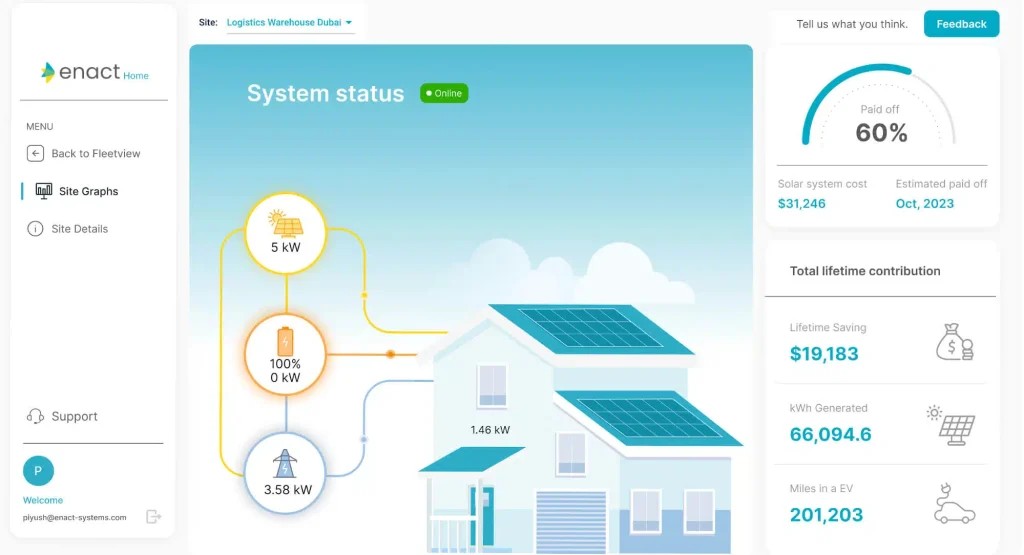
ENACT Solar covers the installer’s side of a solar project from remote design to the years after commissioning: 3D layout and shading, battery sizing, financial modeling, a signed proposal and then monitoring, including an Enact Home app where owners compare actual and estimated generation.

It suits small and mid-sized installers, mostly residential, that want design, proposals and customer monitoring from one vendor. It is a weaker fit for high-volume commercial work, which the base plan caps, and for firms that want permitting and installation tracking built in.

What Is ENACT Solar?

ENACT Solar is made by Enact Systems of Pleasanton, California, founded in 2014 by Deep Chakraborty and Manasij Kar. More than 500 solar companies had used its design and proposal software by September 2024, and Enact reports users in over 35 countries.

It has three modules: Design and Proposals (remote 3D solar design tools and sales proposals for residential and commercial projects), Engineering (the PVCAD AutoCAD plug-in for permit-ready drawings, added when Enact and PVComplete combined in January 2026) and Asset Management (monitoring of installed systems).

Features

  • Remote 3D Design and Modeling: Model roofs from satellite imagery; roof height and pitch are detected automatically from a Digital Surface Model (DSM).
  • Automated Shading Analysis: Run several shading scenarios and drop panels with poor solar access.
  • Financial Modeling: Compare cash, loan, lease and PPA cash flows against utility tariffs looked up by zip code.
  • Proposal Generation: Branded templates with regional pricing, signed through DocuSign.
  • Consumer Asset Management: The Enact Home app shows owners system performance and monthly savings.
  • Storage Sizing: Size batteries with solar and simulate time-of-use charge and discharge for any day of the year.
  • Design as a Service (DaaS): Order proposals or permit-ready plan sets from ENACT’s design team, usually within 24 hours (48–72 hours for 500 kW–2 MW).

ENACT Solar Pricing

Each module is a separate subscription.

  • Free Trial: Available for the design and proposal app; length and limits are not published.
  • Design and Proposals: $279/month billed annually, or $299/month billed monthly.
  • Plan Limits: The monthly plan is listed for 2 users; residential projects are unlimited, but new commercial projects are capped at 10 per month.
  • Design as a Service: Per job, from $20 per residential proposal to $199 for commercial systems over 1 MW; permit-ready plan sets cost $150–$1,150.
  • Engineering and Monitoring: PVCAD costs $267/month billed annually ($347 monthly) with your own AutoCAD license, or $333/month with AutoCAD bundled; Asset Management is priced on request.

Integrations

ENACT also links to Blu Banyan’s SolarSuccess ERP (built on NetSuite), which handles project management and passes BOM, inventory and pricing data into proposals.

  • CRM Integrations: A Lead API creates and updates leads from your website or CRM.
  • API Access: A Design API sends design data to a CRM or in-house app.
  • Hardware Integrations: Monitoring data from inverters of different brands, plus utility usage data such as PG&E Share My Data.
  • Financing Integrations: Build proposals with third-party financing such as Palmetto LightReach lease and PPA products.

How to Set Up ENACT Solar

  1. Sign up for a free trial or request a product demo.
  2. Set up proposal templates, regional pricing and preferred equipment.
  3. Invite sales and project management team members.
  4. Connect CRM and financing integrations.
  5. Create your first solar design and proposal.

How to Use ENACT Solar

A designer enters the property address, builds the roof model from satellite imagery and lays out panels while the software calculates shading and production.

Sales teams then add financing, generate the proposal and send it for e-signature. After installation, the installer watches the system in the Fleetview dashboard and the owner follows generation and savings in the Enact Home app.

What You Can Manage with ENACT Solar

  • 3D Roof Models: Roofs, obstacles and trees, with DSM heights updated every three months.
  • Sales Proposals: Pricing, BOM, shade report, bill savings and cash flow.
  • Customer Contracts: Templates filled with each project’s design and pricing data.
  • Solar Asset Monitoring: All installed systems in one Fleetview dashboard, any inverter brand, with offline alerts and monthly customer reports.
  • Financial Reporting: Monthly savings and payback (“Percent Paid Off”) against system cost.

FAQs

What does ENACT Solar do?

ENACT Solar designs solar and storage systems remotely, turns them into e-signed sales proposals and monitors them after installation.

Who is ENACT Solar best for?

Small and mid-sized installers and their sales teams, mainly residential, that want design, proposals and customer monitoring from one vendor.

Is ENACT Solar free?

No. There is no free plan; Design and Proposals starts at $279/month billed annually. A trial and live demos are available, but the trial length is not published.

What are the main limitations of ENACT Solar?

The base plan caps commercial work at 10 new projects a month, permit drawings need the separately billed PVCAD plug-in, and project management relies on the Blu Banyan ERP integration.

What are the best alternatives to ENACT Solar?

Popular alternatives include Aurora Solar, HelioScope, OpenSolar, and, for monitoring only, SolarEdge’s monitoring platform.

ENACT Solar alternatives

  • PV F-CHART

    by F-Chart Software

    Photovoltaic system analysis software that estimates monthly performance and economics using utilizability methods developed at the University of Wisconsin.
    $400 / one-timeFree trial
    Review
  • PVCAD

    by PVComplete

    AutoCAD-based solar design plugin from PVComplete for producing permit-ready layouts and single-line diagrams for commercial and utility-scale PV projects.

    $180 / user / monthFree trial
    Review
  • PlantPredict

    by Terabase Energy

    Cloud-based energy simulation software for utility-scale PV plants, originally created by First Solar and now part of Terabase Energy.


    $150 / monthFree plan
    Review