Leap
Pros
- Provides a software-only path to energy market revenue without requiring new hardware installations.
- Highly scalable architecture capable of managing hundreds of thousands of individual energy sites.
- Simplifies a fragmented regulatory landscape by providing a single point of entry for multiple grid programs.
- Automated dispatch reduces the operational workload placed on technology providers.
- Strong focus on partner branding through customizable enrollment workflows.
- Proven track record with large-scale deployments in major competitive energy markets.
Cons
- Lack of transparent pricing makes it difficult for smaller startups to estimate initial costs or margins.
- Heavy focus on U.S. energy markets may limit its usefulness for international providers.
- Success depends on the participation levels and reliability of the partner’s end-customer fleet.
- Requires technical resources to manage API integration and hardware-side control logic.
- Provides limited value for companies without enough distributed resources to meet market minimums.
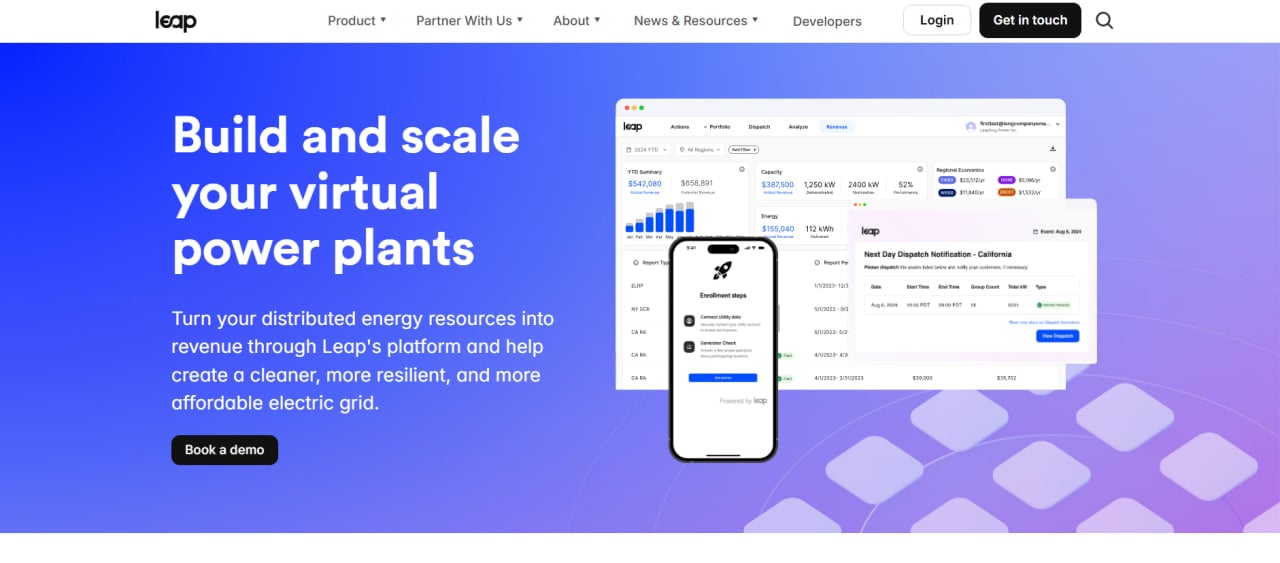
The transition toward a decarbonized electrical grid requires a shift from centralized power plants to distributed energy resources (DERs) like battery storage, electric vehicles, and smart thermostats. However, connecting these diverse assets to wholesale energy markets is often a complex and expensive barrier for technology companies. Leap solves this problem by providing a software-only bridge that aggregates decentralized assets into virtual power plants (VPPs).
Technology providers and fleet operators use Leap to monetize their customers’ flexible energy capacity. By automating the process of responding to grid signals, Leap helps stabilize the electric grid while generating financial rewards for partners and end-users. This platform approach allows companies to offer energy services without needing to build their own market integration infrastructure from scratch.
What Is Leap?
Leap is a Software-as-a-Service (SaaS) platform categorized as a Virtual Power Plant (VPP) enabler. Unlike hardware-based energy management systems, Leap is a software-only solution designed to connect distributed energy resources to energy markets and grid service programs. Its primary mission is to simplify the way technology providers interact with the energy grid, transforming “dumb” assets into interactive participants in the energy economy.
The platform serves a variety of partners, including EV charging companies, residential battery installers, and commercial HVAC developers. Leap works by virtually aggregating these DERs and bidding their combined flexibility into demand response programs and wholesale markets.
Verified trust signals for the platform include its management of over 400,000 energy sites and devices across major U.S. markets and partnerships with over 100 technology providers.
Features
- Energy Market Access: Provides an automated gateway to wholesale markets and utility demand response programs, removing the need for partners to manage regulatory compliance or market bidding manually.
- Universal API: Offers a single interface for developers to connect various device types—such as batteries, thermostats, and EV chargers—to the grid regardless of the underlying hardware manufacturer.
- Automated Dispatch: Sends real-time signals to connected devices to shift or reduce load during peak demand periods, ensuring high performance in grid events without manual intervention.
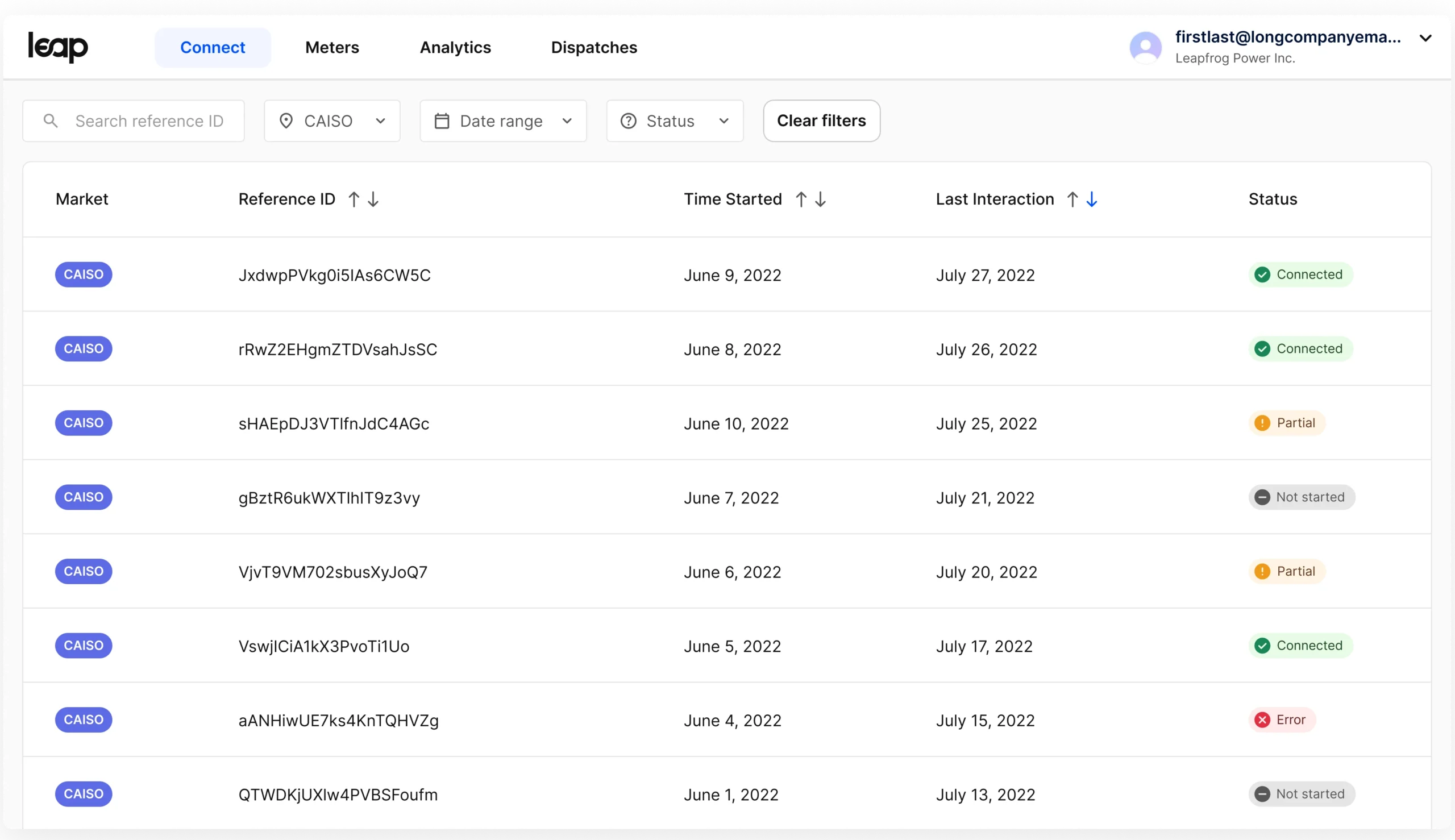
- Partner-Branded Enrollment: Includes Leap Connect, a feature that allows partners to maintain their brand identity while guiding customers through the VPP enrollment and authorization process.
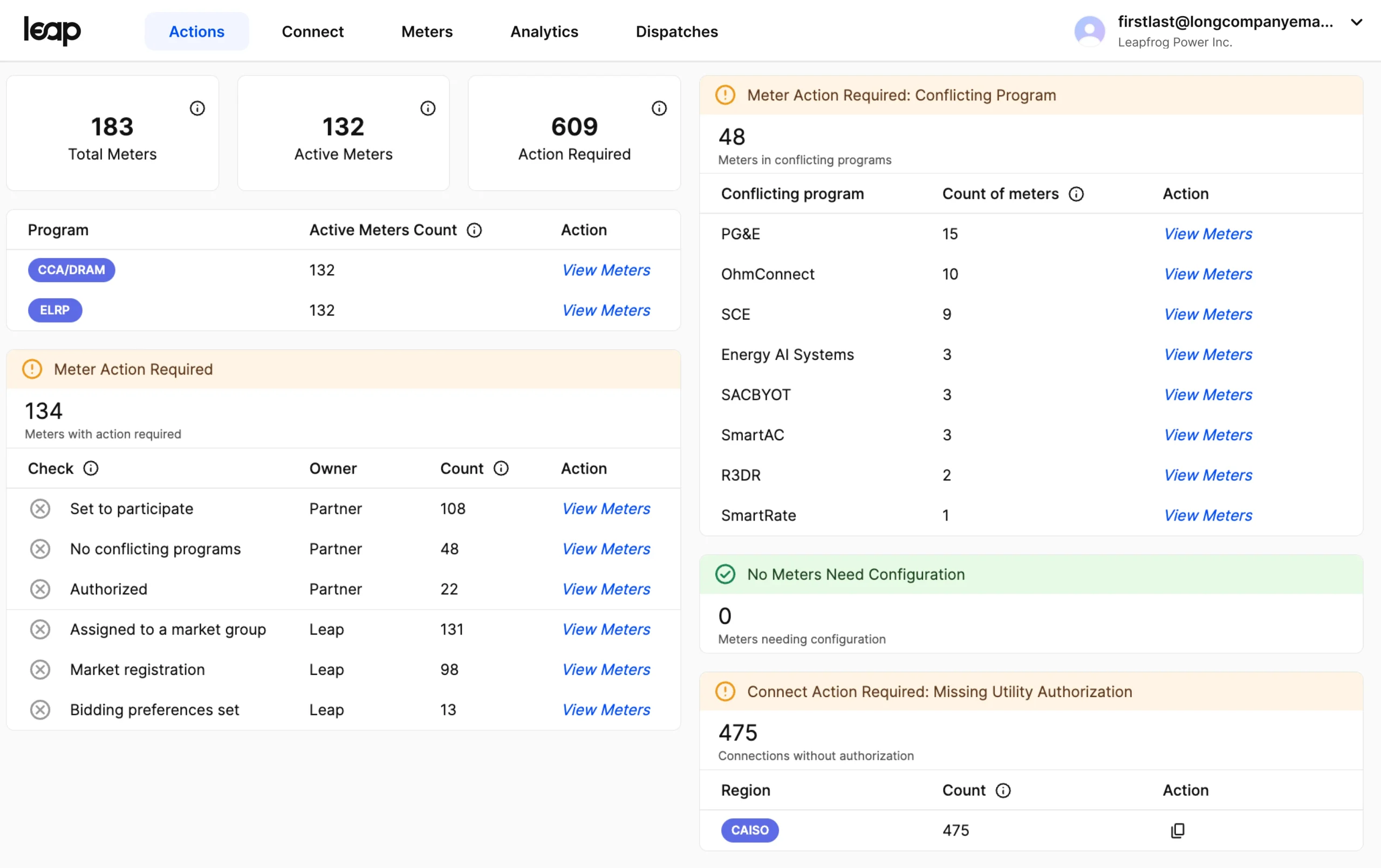
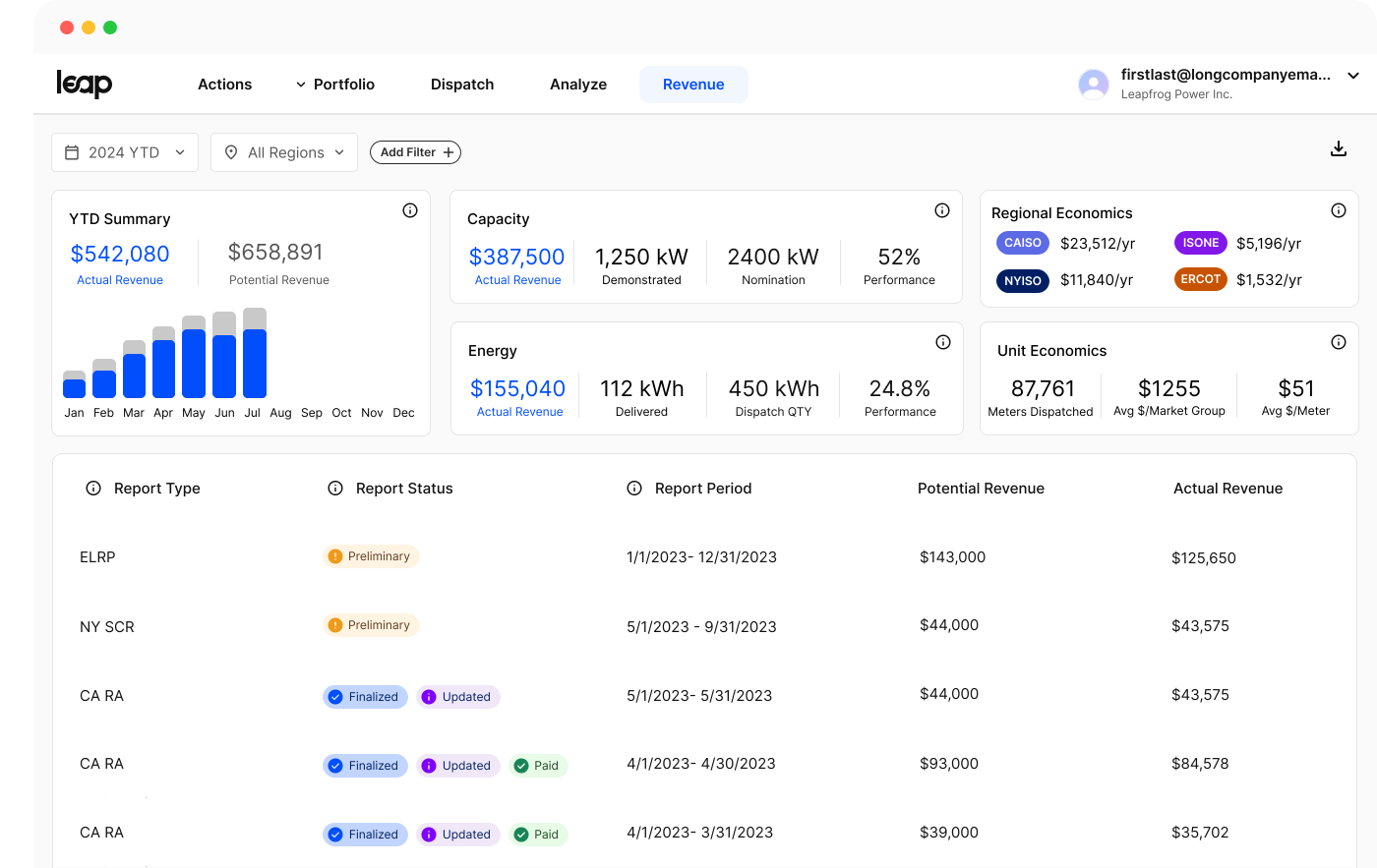
- Portfolio Management Dashboards: Provides visibility into fleet performance, allowing asset managers to track how many devices are enrolled, their historical performance, and earned revenue.
- Revenue-Sharing Tools: Simplifies the financial aspects of VPP participation by calculating and distributing earned incentives between the platform, technology provider, and end customer.
- Grid Services Optimization: Uses data to determine the most profitable times and programs for asset participation, maximizing the financial value of each kilowatt-hour of flexibility.
Screenshots
Leap Pricing
Pricing is not publicly listed. Leap is quoted per deployment, so the number depends on what the sales team scopes with you.
Platforms in the VPP market commonly operate through a performance-based or revenue-sharing model. This means Leap may receive a percentage of the revenue generated from energy market participation instead of charging a traditional flat SaaS fee.
This model aligns the platform’s revenue with the actual grid services delivered by a partner’s fleet.
Integrations
Leap is designed as an integration-first platform that connects hardware assets to utility and wholesale energy markets.
- Hardware and IoT Integrations: Connects with smart thermostats such as Google Nest, residential batteries, EV chargers such as Wallbox, and commercial HVAC controls.
- Utility and Market Integrations: Integrates with major U.S. Independent System Operators and Regional Transmission Organizations, including CAISO in California, NYISO in New York, and PJM in the Eastern United States.
- APIs and Webhooks: Provides a comprehensive API suite that allows technology partners to build custom energy management applications using Leap’s market infrastructure.
- Customer Onboarding Tools: Connects with utility data providers to verify customer eligibility and historical energy usage during enrollment.
How to Set Up Leap
- Schedule a discovery call with the Leap team to discuss your fleet size and target energy markets.
- Complete a technical review to ensure your hardware controls can respond to Leap’s dispatch signals.
- Sign a partnership agreement outlining the revenue-sharing or fee structure.
- Use Leap’s Universal API to integrate your device management platform with the Leap cloud.
- Launch the Leap Connect enrollment workflow for your customer base to begin aggregating assets.
- Begin participating in grid events and receiving performance-based revenue.
How to Use Leap
The day-to-day workflow for a fleet manager using Leap centers around monitoring the Virtual Power Plant dashboard. Managers check the status of their fleet to see how many devices are currently online and eligible for dispatch.
When an energy market or utility signals a grid event, such as a period of high demand, Leap automatically instructs the partner’s devices to reduce load or discharge power.
Following an event, users review performance data to see how accurately their fleet responded to the signal. This data is essential for optimizing future participation and ensuring customers are correctly compensated.
The platform handles the complex backend work of calculating market settlements and clearing financial incentives, allowing users to focus on fleet growth and customer engagement.
What You Can Manage with Leap
- Virtual Power Plants: Create and scale digital aggregations of diverse energy assets.
- Grid Service Revenue: Track and manage financial incentives earned from demand response and frequency regulation.
- Customer Enrollments: Oversee the lifecycle of customer participation, from initial registration to utility authorization.
- Dispatch Performance: Access detailed analytics showing how effectively devices responded to grid signals.
- Market Participation: Manage the specific energy programs and geographic regions in which a fleet participates.
FAQs
What does Leap do?
Leap provides a software platform that connects distributed energy resources, such as batteries and EV chargers, to wholesale energy markets. It allows technology companies to create virtual power plants that help balance the electrical grid in exchange for financial incentives.
Who is Leap best for?
The platform is designed for technology providers, fleet operators, and energy service companies that manage decentralized energy assets. It is ideal for organizations that want to unlock new revenue streams from their hardware without building complex market integration software.
Is Leap free?
No, Leap does not offer a free version of its platform. Because it operates as a B2B infrastructure provider, pricing is typically customized based on fleet size and the specific energy markets being accessed.
Does Leap support integrations?
Yes. Leap supports integrations with batteries, EV chargers, smart thermostats, HVAC systems, utility data providers, and major U.S. energy markets. Technology partners can connect their platforms through Leap’s APIs and webhooks.
What are the main limitations of Leap?
Leap is primarily a software-only bridge, meaning it does not provide the physical hardware or manage the end-customer relationship itself. Its availability is also concentrated in specific U.S. energy markets that permit third-party DER aggregation.
What are the best alternatives to Leap?
Common alternatives in the VPP and grid services market include Voltus, CPower, Enel North America, and AutoGrid. The best option depends on geographic coverage, supported asset types, fleet size, and energy market requirements.