Blink Charging
Pros
- Flexible business models ranging from host-owned to Blink-owned ""turnkey"" solutions.
- One of the fastest Level 2 charging capacities available (up to 80 amps).
- Robust interoperability with major automotive brand apps and third-party roaming networks.
- Specialized fleet management features including local load balancing and plug-and-charge.
- High-visibility hardware options with integrated advertising screens for revenue diversification.
- Global network presence providing reliable coverage for long-distance travel.
Cons
- Pricing for drivers can be higher than competitors, especially for non-members or in regions with minute-based billing.
- Hardware-centric value; the most advanced features often require the latest Blink-specific hardware.
- Network reliability can vary by region depending on local maintenance partnerships.
- Complexity in choosing between multiple ownership and revenue-sharing models for new hosts.
The transition to electric vehicles (EVs) presents both an opportunity and a logistical challenge for property owners, fleet managers, and municipalities. As the demand for accessible charging grows, businesses need a reliable way to deploy hardware and manage energy usage, user access, and payment processing.
Blink Charging solves these problems by providing an end-to-end ecosystem that combines high-performance charging stations with a sophisticated cloud-based management platform. By offering flexible business models and hardware suited for everything from residential use to high-traffic commercial hubs, the company helps organizations build and maintain a functional charging infrastructure.
What Is Blink Charging?
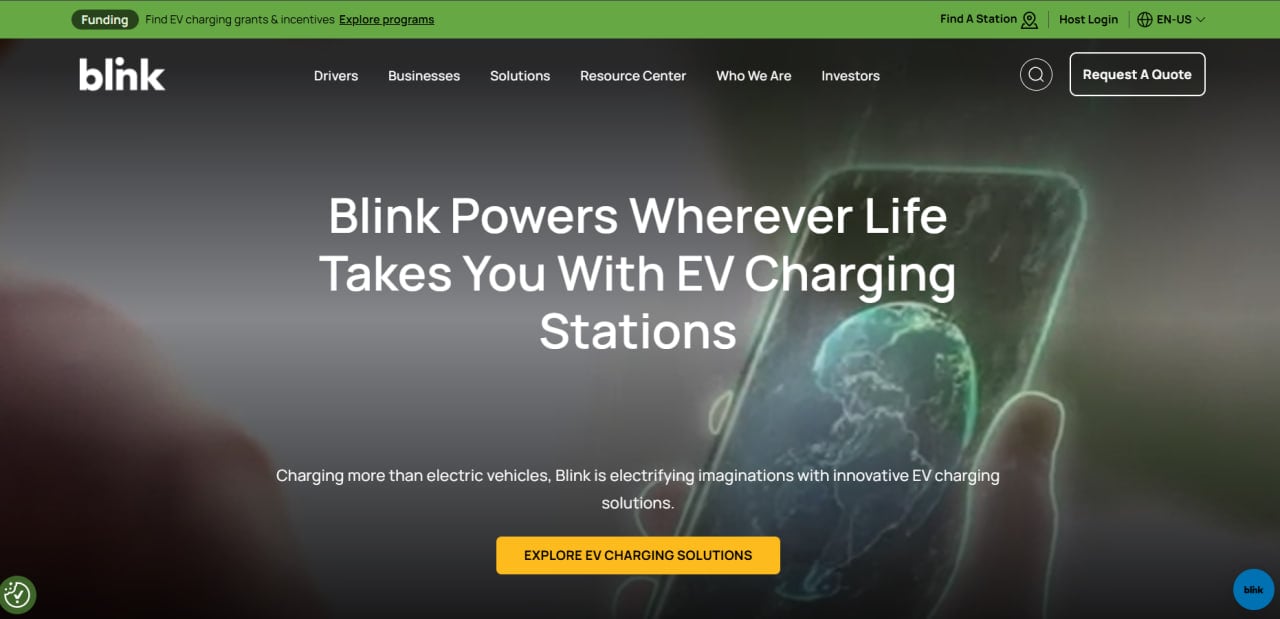
Blink Charging is a leading provider, owner, and operator of electric vehicle charging equipment and services. It falls under the category of EV Charging Network Management and operates one of the largest charging networks in North America. The platform serves a diverse range of users, including commercial real estate owners, multifamily residential managers, fleet operators, and individual EV drivers.
At its core, the platform operates through the Blink Network, a proprietary cloud-based system that connects charging stations to a centralized management interface. This allows property owners to monitor their chargers in real time, set custom pricing, and analyze usage data. For drivers, the platform provides a mobile app to locate chargers, initiate sessions, and handle payments seamlessly. With thousands of stations deployed globally and a presence in over 25 countries, Blink is a major player in the global electrification movement.
Features
- Real-Time Monitoring: Enables station owners to track the status of their chargers remotely, ensuring they are operational and identifying maintenance needs immediately.
- Customizable Charge Rates: Allows host locations to set different pricing for specific user groups, such as employees, residents, or the general public, providing flexibility in revenue generation.
- Blink Mobile App: Provides drivers with an intuitive interface to find available chargers, filter by connector type, and view estimated costs before starting a session.
- Fleet Management Portal: Offers specialized tools for fleet managers to track vehicle energy consumption, manage load across multiple chargers, and export detailed reporting for operational audits.
- Plug-and-Charge Capability: Simplifies the user experience on compatible hardware (like the MQ 200) by automatically identifying the vehicle and processing payment when plugged in, removing the need for apps or cards.
- Smart Load Management: Distributes available power across multiple chargers at a single site, preventing electrical overloads and helping businesses avoid expensive infrastructure upgrades.
- Vision LCD Screens: Integrates high-resolution displays into charging units (like the Vision IQ 200), allowing businesses to display advertisements or internal communications while vehicles charge.
Screenshots


Blink Charging Pricing
Blink Charging utilizes several pricing models depending on whether the user is a driver or a host location.
For Host Locations
- Equipment Purchase: Businesses can buy hardware outright and manage it via the Blink Network for a subscription fee.
- Blink-Owned Model: Blink provides the equipment and installation at no cost to the host, sharing a portion of the charging revenue with the property owner.
- Hybrid Models: Various partnership tiers are available where costs and revenues are shared between Blink and the host.
- Enterprise Quotes: Software-as-a-Service (SaaS) fees for network management and fleet portals are typically provided via custom quotes based on the number of ports and required features.
For EV Drivers
- Membership Tiers: Joining the Blink Network is free, though members often receive discounted rates (typically 20% or more) compared to guests.
- Usage-Based Fees: In states where kWh pricing is legal, rates often range from $0.39 to $0.79 per kWh. In other regions, fees are calculated by the minute (e.g., $0.04 to $0.06 per minute).
- Session Fees: A standard $0.49 access fee is often applied to sessions to fund network improvements.
- Occupancy/Parking Fees: Some locations may charge fees if a vehicle remains plugged in after charging is complete to encourage station turnover.
Integrations
Blink Charging maintains an open approach to interoperability through several key partnerships:
- Automotive Brand Apps: Drivers of BMW, GM (GMC, Chevrolet, Cadillac, Buick), and Ford vehicles can locate and pay for Blink chargers directly through their respective brand-specific mobile applications.
- Roaming Networks: Seamless integration with Shell Recharge, ChargePoint, and ChargeHub allows users of those platforms to access Blink stations without needing a separate Blink account.
Fleet and Management Tools
- WEX: Fleet drivers can use WEX RFID cards for payment, with all data consolidated into a single company invoice.
- AssetWorks: Integrates with FuelFocusEV to provide fleet managers with automated data on energy usage and costs.
- Emobi: A partnership that connects Blink’s infrastructure to a broader roaming and “”JustPlug”” ecosystem for automated charging.
Payment Integrations
Supports standard RFID cards, mobile wallets, and is working toward integrating cryptocurrency payment options.
How to Set Up Blink Charging
- Consult with a Blink specialist to determine your site’s electrical capacity and choose between host-owned or Blink-owned models.
- Select and order the appropriate hardware (Level 2 for long-duration parking or DC Fast Chargers for high-traffic areas).
- Coordinate professional installation and connection to the local electrical grid and the Blink Network (via Wi-Fi, Ethernet, or 4G LTE).
- Register your site on the Blink management portal to set up your host profile.
- Configure your charging policies, including user groups, pricing schedules, and access hours.
- Publish your station to the Blink Mobile App to allow drivers to find and use your chargers.
How to Use Blink Charging
For a station host, the daily workflow involves logging into the cloud dashboard to monitor active sessions and station uptime. Managers can generate weekly reports to analyze revenue and energy consumption, adjusting pricing if utility costs fluctuate. If an alert indicates a station is offline, the host can troubleshoot remotely or request service through the portal.
For a driver, the experience starts with the Blink Charging App to find a nearby station. Once at the charger, the driver plugs in the vehicle. Depending on the station type, they initiate the session by tapping an RFID card, using the app, or via “”Plug-and-Charge”” for supported vehicles. The driver can monitor the charging progress and costs in real time on their phone, receiving a notification once the battery is full.
What You Can Manage with Blink Charging
- Charging Network: Centralized control of multiple charging locations from a single interface.
- Revenue Streams: Automated collection and distribution of payments from public users.
- Energy Load: Distribution of power across units to prevent peak demand charges.
- User Access: Permission-based access for specific groups like residents or fleet drivers.
- Usage Analytics: Detailed reports on energy delivered, CO2 saved, and session durations.
- Hardware Health: Real-time status updates and diagnostic data for all connected equipment.
FAQs
What does Blink Charging do?
Blink Charging provides the hardware, software, and network connectivity required to operate electric vehicle charging stations. It allows property owners to offer charging as a service while providing drivers with a reliable network to power their vehicles.
Who is Blink Charging best for?
The platform is ideal for commercial property owners, multifamily residential managers, and fleet operators who need a scalable charging solution. It also serves individual EV drivers who require a widespread network for public charging.
Is Blink Charging free?
While the mobile app and basic membership are free to join, there is almost always a cost associated with charging a vehicle. Host locations must also pay for hardware or enter into revenue-sharing agreements to use the Blink Network.
What are the main limitations of Blink Charging?
The primary limitations include a complex pricing structure that varies by state and membership status, and a dependency on Blink-compatible hardware to access the full suite of management features. Additionally, some users find guest pricing to be higher than other major networks.
What are the best alternatives to Blink Charging?
Major alternatives include ChargePoint, which offers a similar cloud-based management platform, and Schneider Electric or Siemens for industrial-scale hardware. Tesla’s Supercharger network is a primary competitor for high-speed public charging.